Book Review: Forever Changes: Arthur Lee and the Book of Love
by: Denise Sullivan
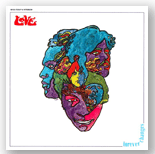
Forever Changes: Arthur Lee and the Book of Love
By John Einarson
(Jawbone, 2010)
“The Doors looked at Love as the band they wanted to be like: Successful, mysterious, and profound,” says drummer Michael Stuart in Forever Changes: Arthur Lee and the Book of Love. “But the Doors were hard workers, and the other guys in the band had more control over Jim Morrison than we had over Arthur.” If you know anything about the habits of Jim Morrison and how the Doors suffered at his hands, then perhaps that gives you some idea about the crazy world of Arthur Lee. Some say he lived many lifetimes in his 61 years, any one of them as extreme as Jimbo’s, but those who dared to control him would find themselves confronted by a man with a formidable will—the sheer force of which worked against him more than for him. His and his band Love’s story is a rock tragedy of epic proportions.
From their earliest gigs at the Brave New World as the Grass Roots (named after the Malcolm X speech, Message to the Grass Roots), Lee and Love were anomalous in their field. Inspired by jazz, blues, and the Byrds, Lee was the original “black hippie,” a psychedelic rock pioneer and unreliable bandleader with an extraordinary bad luck streak. Out of the gate, he felt gypped when another group had already established themselves as the Grass Roots. But with his guitarist pal Johnny Echols, and Lee’s own signature one boot and harmonica, the newly christened Love and their collective style didn’t miss a beat when it came to capturing the spirit of the freewheeling times on the mid-’60s Sunset Strip scene where they were readily embraced by the teenage girls who made and broke the bands there.
The fact that Lee and Echols were black at a time of local and national racial crisis was incidental in their immediate milieu, though in retrospect, it’s just another way that Love broke ground among their psychedelic peers. With his odd glasses and ability to shapeshift from crooner to rock ‘n’ soul shouter, Lee never bowed to prevailing trends or fashions, creating his own wild style and far-reaching compositions. None other than Jimi Hendrix took inspiration from him, a fact Lee felt ambivalent about, considering he counted Jimi as a friend and fellow traveler, as well as a competitor. But the kinds of business decisions Lee made (like opting out of the festival at Monterey because of a personal grievance he had with its organizer Lou Adler) were almost always to his detriment, based as they were on hot emotions and cold fear. Serving to impede Love’s progress, by 1968 the classic band was in essence, kaput, though Lee weathered other line-ups and a solo career of sorts.
Devastatingly talented, with the ability to compose complex parts and high concept pieces, Lee was crippled by a deep-seeded mistrust of humanity that often left cooperative ventures in shreds. If the stories told to the author by former band members, friends, business associates, fans, and girlfriends are to be believed, Lee threw away every last possible chance for success and the horse it rode in on; if only half of the anecdotes are true, the sum total mishaps would still add up to enough missed opportunity to fill nine lives instead of this cat’s one and only. Given the evidence of the wreckage, the singer couldn’t have asked for a more sympathetic biographer than Canada-based Einarson. Known primarily for his work in UK rock mags like MOJO and Uncut, he combined the old stories with an unpublished manuscript of Lee’s—provided with the blessing of his long suffering spouse, Diane Lee—and turned out a moving account.
Yet for all his peccadilloes, Lee had no shortage of fans and friends in rock: Neil Young nearly produced an album and Jimmy Page and Robert Plant made a pilgrimage to his house (though Lee rebuffed their entrée with one of his characteristic slurs: “**** those dudes!”). He also blew out a ’70s comeback arranged with the help of Eric Clapton by offending moneyman Robert Stigwood. This is pretty much how it goes throughout four decades of music and mayhem until eventually Lee lands in the state pen on a third strike: “Only God is my judge,” he said to the court, which nevertheless sentenced him to 12-plus years, of which he served nearly six. But following his early release and a promising series of comeback dates that included performances of the classic material from Forever Changes and formal recognition by the English House of Parliament for his contribution to rock, Lee picked up drugs again. Reportedly self-medicating the pain from his soon to be diagnosed leukemia, he died without medical insurance in his birthplace of Memphis in 2006.
Was this any way for a West Coast ’60s rock maestro to have lived and died? Probably not, but Lee did it his way, which was the only way he knew how. In all of its efforts to set the record straight, The Book of Love only calcifies Lee’s reputation as one of rock’s most difficult personalities. For every denial on his part and that of his confidantes, there are at least three more stories that place Lee at the center of the chaos. The suggestion that he was the spoiled only child of elderly parents who doted on him does not suffice as a reason for the character flaws, though racism in the courtroom and California’s three strikes system can certainly be blamed for derailing him in later years. But Lee lived without regret. “The only regret Arthur ever had was that he couldn’t hit the high note that Jackie Wilson could hit,” said his widow, Diane. Lee’s greatest affirmation that he did something right remains Love, its music still lifting listeners higher and higher, forty-five year on: May his defiant soul rock on.
Crawdaddy Review...gotta love LoVE
Moderator: The Freedom Man
-
jamestkirk
- Senior Member
- Posts: 5816
- Joined: Tue Mar 20, 2007 9:11 pm
- Location: The Music Of My Mind
Crawdaddy Review...gotta love LoVE
"After silence, that which comes nearest to expressing the inexpressible is music".
-Aldous Huxley
-Aldous Huxley