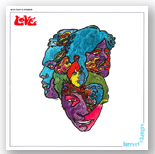
LoVE connections remembered by RW...
So the Standells LoVE connection was original Love bassist John Fleck (Fleckenstein), who left Love to play in the Standells, and the Walker Brothers was Standell Gary Leeds, who left them to become a Walker Brother.
Standells Drummer and Singer Dick Dodd dead at 68
Garage rockers' hit 'Dirty Water' became a Boston anthem
By MIRIAM COLEMAN
DECEMBER 1, 2013 6:37 PM ET
Dirty Water...love the lip-sync fun they're having
http://www.youtube.com/watch?v=5apEctKwiD8

Dick Dodd performs with The Standells on "Shindig" on March 24th, 1965.
ABC Photo Archives/ABC via Getty
Dick Dodd, singer and drummer for garage rockers the Standells, died on Friday at the age of 68. The band was best known for its 1966 hit, "Dirty Water," which became an unofficial anthem for the city of Boston and its sports teams.
Dodd, who was born in Hermosa Beach, California in 1945, got his start in show business at the age of 9 as a Mouseketeer on The Mickey Mouse Club. In the early 1960s, he played in two pioneering surf rock bands, the Bel-Airs and Eddie and the Showmen, performing alongside acts like the Beach Boys and the Righteous Brothers. He also continued to appear on television shows and was a dancer in the 1963 film musical Bye Bye Birdie.
In Memoriam: Musicians We Lost
Dodd joined the Standells as drummer and vocalist in 1964. Two years later, the garage-rockers scored their biggest hit, "Dirty Water," which peaked at Number 11 on the Billboard Hot 100 on July 9th, 1966. The song was written by producer Ed Cobb, and despite its references to the Boston Strangler and local muggers, the refrain "Boston, you're my home" made it a favorite victory soundtrack at Red Sox, Bruins and Patriots games.
The band achieved more moderate success with songs including "Riot on Sunset Strip" (the theme song to the exploitation film of the same name), "Why Pick On Me?" and "Sometimes Good Guys Don’t Wear White."
Dodd continued performing with the Standells into the last year of his life, and also worked as a limousine driver in his hometown of Buena Park. The Los Angeles Times reports that he announced earlier this year that he had stage four cancer and died at a hospital in Orange County, California.
........................
Dick Dodd dies at 68; Mouseketeer and musician
Dick Dodd was a member of two of the earliest and most influential surf bands — the Bel-Airs and Eddie and the Showmen — before a sharp turn to garage rock with the Standells.
Dick Dodd, a Mouseketeer on Disney's original "Mickey Mouse Club" who went on to become a surf music pioneer and a youth-quaking garage rock showman, died Friday in a Fountain Valley hospital, said his close friend, Tim Ferrill. Dodd was 68.
Dodd announced earlier this year on his website that he had stage 4 cancer. Born Joseph Richard Dodd Jr. on Oct. 27, 1945, in Hermosa Beach, Dodd cultivated an interest in singing, dancing and performing as a young boy. In 1955, at the age of 9, he was cast on "The Mickey Mouse Club," the beloved television variety show that came to epitomize post-war America, alongside series regulars such as Annette Funicello and Cubby O'Brien. On the show, he was the Mouseketeer known as Dickie.
"It was the best training I could have had as a kid," Dodd told The Times in 1990. "You had to learn fast. You didn't horse around. Even though you were a kid, you had to hit your marks and learn your parts."
In the early 1960s, Dodd was a member of two of the earliest and most influential surf rock bands — the Bel-Airs, which nabbed a hit with the 1961 instrumental "Mr. Moto," and Eddie and the Showmen, which performed on the same bill as some of the luminaries of the era including the Beach Boys, Sonny and Cher and the Righteous Brothers.
A kind of pop cultural "Where's Waldo," Dodd also went on to appear on a number of television shows and was a dancer in the 1963 film version of the musical "Bye Bye Birdie."
But in 1964, Dodd took a musical left turn out of the mainstream to become drummer-vocalist in the garage rock band the Standells, known primarily for their popular single "Dirty Water." Recorded in 1965, it became the Standells' first and only hit, peaking at No. 11 on the national singles chart. And with its unforgettable refrain, "Boston, you're my home," the song held a special renown in Beantown where it's still an anthem for its sports teams, including the Red Sox baseball team and hockey-playing Bruins.
The Standells also went on to provide a soundtrack to the clash between counter-culture revelers and the establishment in 1967 with Dodd singing their second best-known song, "Riot on Sunset Strip," on camera during the opening credits of a low-budget exploitation movie of the same name.
"When he opened his mouth, there was that voice: snotty and authoritative, an American Mick Jagger sort of voice," said Deke Dickerson, who performed at concerts with Dodd in the last years of his life and booked him to perform at Anaheim's Guitar Geek Festival last year. "It's the sound that captures a particular era in '60s garage music."
In his later years, gigs were sometimes hard to come by and to earn a living he worked as a limousine driver in Buena Park, where he lived. But he did play concerts into this year, sometimes with his oldies outfit the Dodd Squad. As recently as April, he impressed attendees at a Burbank gig with his stage presence and vivacity.
"He was playing great, singing great, commanding the stage and leading the band from behind the drum kit better than anyone ever seen — and he was 67," said Dickerson.
Dodd was separated from his second wife, Janet Dodd. He is also survived by his adult daughter, Nicole.