Essential songs....59 minutes of bliss...listen and read on...
http://www.youtube.com/watch?v=8kZMVG6N7DE

Now we rise and we are everywhere.
--"From The Morning"
http://www.youtube.com/watch?v=Q2JjJPDz3EE
Nicholas Rodney "Nick" Drake (19 June 1948 – 25 November 1974) was an English singer-songwriter and musician, known for his gentle guitar-based songs. He failed to find a wide audience during his lifetime but his work has gradually achieved wider notice and recognition. Drake signed to Island Records when he was 20 years old and a student at the University of Cambridge, and released his debut album, Five Leaves Left, in 1969. By 1972, he had recorded two more albums—Bryter Layter and Pink Moon. Neither sold more than 5,000 copies on initial release. Drake's reluctance to perform live, or be interviewed, contributed to his lack of commercial success. There is no known footage of the adult Drake; he was only ever captured in still photographs and in home footage from his childhood.
Drake suffered from depression, particularly during the latter part of his young life. This was often reflected in his lyrics. On completion of his third album, 1972's Pink Moon, he withdrew from both live performance and recording, retreating to his parents' home in rural Warwickshire. On 25 November 1974, Drake died from an overdose of amitriptyline, a prescribed antidepressant; he was 26 years old. Whether his death was an accident or suicide has never been resolved.
Drake's music remained available through the mid-1970s, but the 1979 release of the retrospective album Fruit Tree allowed his back catalogue to be reassessed. By the mid-1980s Drake was being credited as an influence by such artists as Robert Smith, David Sylvian and Peter Buck. In 1985, The Dream Academy reached the UK and US charts with "Life in a Northern Town", a song written for and dedicated to Drake. By the early 1990s, he had come to represent a certain type of "doomed romantic" musician in the UK music press and was frequently cited as an influence by artists including Kate Bush, Paul Weller, Beck and The Black Crowes. His first biography appeared in 1997, and was followed in 1998 by the documentary film A Stranger Among Us.
Early life
Nick's father, Rodney Drake (1908–1988), had moved to Rangoon, Burma, in the early 1930s to work as an engineer with the Bombay Burmah Trading Corporation. There, in 1934, his father met the daughter of a senior member of the Indian Civil Service, Mary Lloyd (1916–1993), known to her family as "Molly". Rodney Drake proposed to her in 1936, though they had to wait a year until she turned 21 before her family allowed them to marry. In 1950 they returned to England to live in Warwickshire at a house named Far Leys, in the prosperous commuter village of Tanworth-in-Arden just south of Birmingham, the city where Rodney Drake worked from 1952 as the Chairman and Managing Director of Wolseley Engineering. Nick Drake had an older sister, Gabrielle who became a successful film and television actress. Both parents were musically inclined and each wrote pieces of music. Recordings of Molly Drake's songs, which have come to light since her death, are remarkably similar in tone and outlook to the later work of her son. Mother and son shared a similar fragile vocal delivery and both Gabrielle and biographer Trevor Dann have noted a parallel sense of foreboding and fatalism in their music. Encouraged by his mother, Drake learned to play piano at an early age and began to compose songs which he recorded on a reel-to-reel tape recorder she kept in the family drawing room.
In 1957, Drake was sent to Eagle House School, a preparatory boarding school in Berkshire. Five years later, he went to Marlborough College, a public school in Wiltshire, attended by his father, grandfather, and great-grandfather. He developed an interest in sport, becoming an accomplished sprinter over 100 and 200 yards, representing the school's Open Team in 1966. He played rugby for the C1 House team and was appointed a House Captain in his last two terms. School friends recall Drake at this time as having been confident and "quietly authoritative", while often aloof in his manner. His father Rodney remembered, "In one of his reports [the headmaster] said that none of us seemed to know him very well. All the way through with Nick. People didn't know him very much."
Drake played piano in the school orchestra, and learned clarinet and saxophone. He formed a band, The Perfumed Gardeners, with four schoolmates in 1964 or 1965. With Drake on piano and occasional alto sax and vocals, the group performed Pye International R&B covers and jazz standards, as well as Yardbirds and Manfred Mann numbers. Chris de Burgh asked to join the band, but was rejected as his taste was seen as "too poppy" by the other members.[18] Drake's academic performance began to deteriorate, and while he had accelerated a year in Eagle House, at Marlborough he began to neglect his studies in favour of music. He attained seven GCE O-Levels in 1963, fewer than his teachers had been expecting, and he failed "Physics with Chemistry".[19] In 1965, Drake paid £13 for his first acoustic guitar, and was soon experimenting with open tuning and finger-picking techniques.
In 1966 Drake enrolled at a tutorial college in Five Ways, Birmingham, from where he won a scholarship to study English literature at Fitzwilliam College, University of Cambridge. He delayed attendance to spend six months at the University of Aix-Marseille, France, beginning in February 1967. While in Aix, he began to practice guitar in earnest, and to earn money would often busk with friends in the town centre. Drake began to smoke cannabis, and that spring he travelled with friends to Morocco, because, according to travelling companion Richard Charkin, "that was where you got the best pot". Drake most likely began using LSD while in Aix, and lyrics written during this period—in particular for the song "Clothes of Sand"—are suggestive of an interest in hallucinogens.
Cambridge
On returning to England, Drake moved into his sister's flat in Hampstead, London, before enrolling at Cambridge University that October. His tutors found him to be a bright student, but unenthusiastic and unwilling to apply himself to study. Dann notes that he had difficulty connecting with staff and fellow students alike, and points out that official matriculation photographs from this time reveal a sullen and unimpressed young man. Cambridge placed much emphasis on its rugby and cricket teams, yet by this time Drake had lost interest in playing sport, preferring to stay in his college room smoking marijuana, and listening to and playing music. According to fellow student (now psychiatrist) Brian Wells: "they were the rugger buggers and we were the cool people smoking dope." In September 1967, he met Robert Kirby, a music student who went on to orchestrate many of the string and woodwind arrangements for Drake's first two albums. By this time, Drake had discovered the British and American folk music scenes, and was influenced by performers such as Bob Dylan, Josh White and Phil Ochs. He began performing in local clubs and coffee houses around London, and in February 1968, while playing support to Country Joe and the Fish at the Roundhouse in Camden Town, made an impression on Ashley Hutchings, bass player with Fairport Convention. Hutchings recalls being impressed by Drake's skill as a guitarist, but even more so by "the image. He looked like a star. He looked wonderful, he seemed to be 7 ft."
Hutchings introduced Drake to the 25-year-old American producer Joe Boyd, owner of the production and management company Witchseason Productions. The company was, at the time, licensed to Island Records, and Boyd, the man who had discovered Fairport Convention and been responsible for introducing John Martyn and The Incredible String Band to a mainstream audience, was a significant and respected figure on the UK folk scene. He and Drake formed an immediate bond, and the producer acted as a mentor to Drake throughout his career. A four-track demo, recorded in Drake's college room in the spring of 1968, led Boyd to offer a management, publishing, and production contract to the 20-year-old, and to initiate work on a debut album. According to Boyd:
In those days you didn't have cassettes—he brought a reel-to-reel tape [to me] that he'd done at home. Half way through the first song, I felt this was pretty special. And I called him up, and he came back in, and we talked, and I just said, "I'd like to make a record." He stammered, "Oh, well, yeah. Okay." Nick was a man of few words.
In a 2004 interview, Drake's friend Paul Wheeler remembered the excitement caused by his seeming big break, and recalled that the singer had already decided not to complete his third year at Cambridge.
Career
Five Leaves Left
Drake began recording his debut album Five Leaves Left later in 1968, with Boyd assuming the role of producer. The sessions took place in Sound Techniques studio, London, with Drake skipping lectures to travel by train to the capital. Inspired by John Simon's production of Leonard Cohen's first album, Boyd was keen that Drake's voice would be recorded in a similar close and intimate style, "with no shiny pop reverb". He sought to include a string arrangement similar to Simon's, "without overwhelming ... or sounding cheesy". To provide backing, Boyd enlisted various contacts from the London folk rock scene, including Fairport Convention guitarist Richard Thompson and Pentangle bassist Danny Thompson (no relation). He recruited John Wood as engineer, and drafted Richard Hewson in to provide the string arrangements.
Initial recordings did not go well: the sessions were irregular and rushed, taking place during studio downtime borrowed from Fairport Convention's production of their Unhalfbricking album. Tension arose between artist and producer as to the direction the album should take: Boyd was an advocate of George Martin's "using the studio as an instrument" approach, while Drake preferred a more organic sound. Dann has observed that Drake appears "tight and anxious" on bootleg recordings taken from the sessions, and notes a number of Boyd's unsuccessful attempts at instrumentation.Both were unhappy with Hewson's contribution, which they felt was too mainstream in sound for Drake's songs. Drake suggested using his college friend Robert Kirby as a replacement. Though Boyd was skeptical about taking on an amateur music student lacking prior recording experience, he was impressed by Drake's uncharacteristic assertiveness, and agreed to a trial. Kirby had previously presented Drake with some arrangements for his songs. However, Kirby did not feel confident enough to score the album's centerpiece "River Man", and Boyd was forced to stretch the Witchseason budget to hire the veteran composer Harry Robertson, with the instruction that he echo the tone of Delius and Ravel.
He lived a frugal existence, his only source of income being a £20-a-week retainer he received from Island Records. At one point he could not afford a new pair of shoes. He would often disappear for days, sometimes turning up unannounced at friends' houses, uncommunicative and withdrawn. Robert Kirby described a typical visit: "He would arrive and not talk, sit down, listen to music, have a smoke, have a drink, sleep there the night, and two or three days later he wasn't there, he'd be gone. And three months later he'd be back."
Referring to this period, John Martyn (who in 1973 wrote the title song of his album Solid Air for and about Drake) described him as the most withdrawn person he'd ever met. He would borrow his mother's car and drive for hours without purpose on occasion, until he ran out of petrol and had to ring his parents to ask to be collected. Friends have recalled the extent to which his appearance had changed. During particularly bleak periods of his illness, he refused to wash his hair or cut his nails. Early in 1972, Drake suffered a nervous breakdown, and was hospitalized for five weeks.
In February 1974, Drake contacted John Wood, stating he was ready to begin work on a fourth album. Boyd was in England at the time, and agreed to attend the recordings. The initial session was followed by further recordings in July. In his 2006 autobiography, the producer recalled being taken aback at Drake's anger and bitterness: "[He said that] I had told him he was a genius, and others had concurred. Why wasn't he famous and rich? This rage must have festered beneath that inexpressive exterior for years." Both Boyd and Wood noticed a discernible deterioration in Drake's performance, requiring him to overdub his voice separately over the guitar. However, the return to Sound Techniques' studio raised Drake's spirits; his mother later recalled, "We were so absolutely thrilled to think that Nick was happy because there hadn't been any happiness in Nick's life for years."
Death
Drake's gravestone is inscribed with the epitaph 'Now we rise / And we are everywhere', taken from "From the Morning," the final song on his final album, Pink Moon.
By autumn 1974, Drake's weekly retainer from Island had ceased, and his illness meant he remained in contact with only a few close friends. He had tried to stay in touch with Sophia Ryde, whom he had first met in London in 1968. Ryde has been described by Drake's biographers as "the nearest thing" to a girlfriend in his life, but she now prefers the description "best (girl) friend". In a 2005 interview, Ryde revealed that a week before he died, she had sought to end the relationship: "I couldn't cope with it. I asked him for some time. And I never saw him again." As with the relationship he had earlier shared with fellow folk musician Linda Thompson, Drake's relationship with Ryde was never consummated.
At some time during the night of 24/25 November 1974, Nick Drake died at home in Far Leys, Tanworth-in-Arden, from an overdose of amitriptyline, a type of antidepressant. He had gone to bed early after spending the afternoon visiting a friend. His mother said that around dawn he left his room for the kitchen. His family was used to hearing him do this many times before but, during this instance, he did not make a sound. They presumed he was eating a bowl of cereal. He returned to his room a short while later, and took some pills "to help him sleep". Drake was accustomed to keeping his own hours; he frequently had difficulty sleeping and often stayed up through the night playing and listening to music, then slept late into the following morning. Recalling the events of the night, his mother later said: "I never used to disturb him at all. But it was about 12 o'clock, and I went in, because really it seemed it was time he got up. And he was lying across the bed. The first thing I saw was his long, long legs." There was no suicide note, although a letter addressed to Ryde was found close to his bed.
At the inquest in December, the coroner stated that the cause of death was as a result of "Acute amitriptyline poisoning—self-administered when suffering from a depressive illness", and concluded a verdict of suicide. The verdict has been disputed by some members of his family, there is a general view that accidental or not, Drake had by then given up on life. Rodney described his son's death as unexpected and extraordinary; however, in a 1979 interview he admitted to "always [being] worried about Nick being so depressed. We used to hide away the aspirin and pills and things like that." Boyd has said that he prefers to believe the overdose was accidental. He recalled that Drake's parents had described his mood in the preceding weeks as having been very positive, and that he had planned to move back to London to restart his music career. Boyd believes that this levity was followed by a "crash back into despair". Reasoning that Drake may have taken a high dosage of antidepressants to recapture this sense of optimism, he said he prefers to imagine Drake "making a desperate lunge for life rather than a calculated surrender to death".[83] Writing in 1975, NME journalist Nick Kent comments on the irony of Drake's death at a time when he had just begun to regain a sense of "personal balance". In contrast, Gabrielle Drake has said she prefers to think her brother committed suicide, "in the sense that I'd rather he died because he wanted to end it than it to be the result of a tragic mistake. That would seem to me to be terrible."
On 2 December 1974, after a service in the Church of St Mary Magdalene, Tanworth-in-Arden, Drake's remains were cremated at Solihull Crematorium and his ashes later interred under an oak tree in the graveyard of St Mary's.[84] The funeral was attended by around 50 mourners, including friends from Marlborough, Aix, Cambridge, London, Witchseason, and Tanworth.[85] Referring to Drake's tendency to compartmentalise relationships, Brian Wells observed that many met each other for the first time that morning.[86] Molly recalled "a lot of his young friends came up here. We'd never met many of them."
Posthumous popularity
During the early Eighties, I drifted away from the music scene. When I returned, I was surprised to find that Nick Drake was becoming famous.
—Ian MacDonald
There were no documentaries or compilation albums in the wake of Drake's death. His public profile remained low throughout the mid and late 1970s, although occasional mentions of his name appeared in the music press. By this time, his parents were receiving an increasing number of fans and admirers as visitors to the family home in Far Leys. Island Records, following a 1975 NME article written by Nick Kent, stated "we have no intention of repackaging Nick's three albums (which remained available), either now or at anytime in the foreseeable future", but in 1979 Rob Partridge joined Island Records as press officer and commissioned the release of the Fruit Tree box set. Partridge was a fan of Drake's, and had seen him perform early in 1969: "The first thing I did when I got to Island was suggest we put together a retrospective—the studio albums plus whatever else was there. I wasn't necessarily expecting massive vaults with millions of tunes, live recordings or whatever, but there was very little". The release brought together the three studio albums as well as the four tracks recorded with Wood in 1974 and was accompanied by an extensive biography written by the American journalist Arthur Lubow. However, sales were poor and the album received little press notice, and in 1983 Island deleted Fruit Tree from its catalogue.
By the mid-1980s Drake was being cited as an influence by musicians such as R.E.M.'s Peter Buck and Robert Smith of The Cure. Smith credited the origin of his band's name to a lyric from Drake's song "Time Has Told Me" ("a troubled cure for a troubled mind"). Drake gained further exposure in 1985 with the release of The Dream Academy's hit single "Life in a Northern Town", which included an on-sleeve dedication to Drake.In 1986 the first biography of Drake was published, in Danish—it was eventually translated, updated with new interviews, and published in English in February 2012. His reputation continued to grow, and by the end of the 1980s, his name was appearing regularly in newspapers and music magazines in the United Kingdom; he had to many come to represent a "doomed romantic hero", and an "enigma wrapped inside a mystery". The first step in translating that reputation into record sales came with the release of the compilation album Way to Blue: An Introduction to Nick Drake in May 1994. Although the album never charted in the UK, it sold consistently over the next few years, gaining a gold disc certification in September 1999 for sales of 100,000 copies in the UK.
On 20 June 1998 BBC Radio 2 broadcast a documentary entitled Fruit Tree: The Nick Drake Story, featuring interviews with Joe Boyd, John Wood, Gabrielle and Molly Drake, Paul Wheeler, Robert Kirby and Ashley Hutchings, and narrated by Danny Thompson. To tie in with the release of the compilation album Made to Love Magic, an updated version of the documentary was broadcast on 22 May 2004 on Radio 2, retitled Lost Boy: In Search of Nick Drake and featuring the same interview clips but with Thompson's narration replaced by that of Brad Pitt, a self-confessed Nick Drake fan. In early 1999, BBC2 aired a 40-minute documentary, A Stranger Among Us—In Search of Nick Drake. The following year, Dutch director Jeroen Berkvens released the documentary A Skin Too Few: The Days of Nick Drake, featuring interviews with Boyd, Gabrielle Drake, Wood and Kirby. Later that year, The Guardian placed Bryter Layter at number 1 in its "Alternative top 100 albums ever" list.
In 1999, "Pink Moon" was used in "Milky Way", a Volkswagen Cabrio commercial, leading to a large increase in record sales. The US telecommunications company AT&T used "From the Morning" in one of their advertisements as part of their "Rethink Possible" campaign in North America in 2010.
In recent years several musicians, including Lucinda Williams, Ben Folds, Badly Drawn Boy, Lou Barlow and Mikael Åkerfeldt have cited Drake as an influence. In 2004, nearly 30 years after his death, Drake gained his first chart placing when two singles, "Magic" and "River Man", were released to coincide with the Made to Love Magic album.
On 16 May 2009 Joe Boyd curated a concert at the Birmingham Town Hall, with Robert Kirby as musical arranger and a variety of singers and musicians performing Drake's songs. Among the featured artists were Robyn Hitchcock, Camille O'Sullivan, Martha Wainwright, Graham Coxon, Beth Orton, Harper Simon, Kate St John, Stuart Murdoch and Vashti Bunyan. Following this concert's success, Boyd staged a short concert tour of the UK in January 2010, following the same format: artists on the tour included Vashti Bunyan, Green Gartside, Lisa Hannigan, Scott Matthews, Teddy Thompson, Krystle Warren, Robyn Hitchcock, Kirsty Almeida and Harper Simon. The concert at the London Barbican Centre was filmed and broadcast on BBC Four in April 2010.
Musical and lyrical style
Drake was obsessive about practising his guitar technique, and would often stay up through the night experimenting with tunings and working on songs. His mother remembered hearing him "bumping around at all hours. I think he wrote his nicest melodies in the early-morning hours." Self-taught, he achieved his guitar style through the use of alternative tunings to create cluster chords. These are difficult to achieve on a guitar using standard tuning; Drake used tunings which made cluster chords available using more conventional chord shapes. In many songs he accents the dissonant effect of such non-standard tunings through his vocal melodies.
Drake studied English literature at Cambridge and was particularly drawn to the works of William Blake, William Butler Yeats and Henry Vaughan, and his lyrics reflect such influences. Drake also employs a series of elemental symbols and codes, largely drawn from nature. The moon, stars, sea, rain, trees, sky, mist and seasons are all commonly used, influenced in part by his rural upbringing. Images related to summer figure centrally in his early work; from Bryter Layter on, his language is more autumnal, evoking a season commonly used to convey senses of loss and sorrow. Throughout, Drake writes with detachment, more as an observer than participant, a point of view Rolling Stone's Anthony DeCurtis described "as if he were viewing his life from a great, unbridgeable distance." Kirby described Drake's lyrics as a "series of extremely vivid, complete observations, almost like a series of epigrammatic proverbs", though he doubts that Drake saw himself as "any sort of poet". Instead he believes that Drake's lyrics were crafted to "complement and compound a mood that the melody dictates in the first place."
Discography
Five Leaves Left (1969)
Bryter Layter (1970)
Pink Moon (1972)
..............................................................
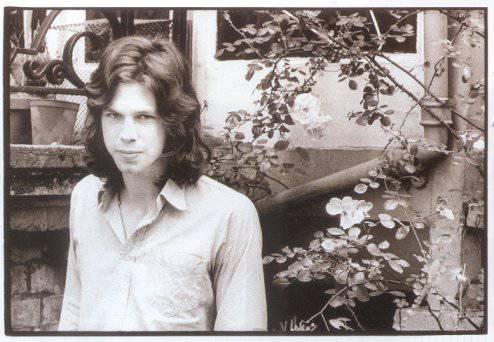
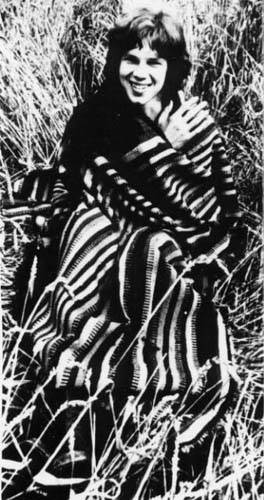
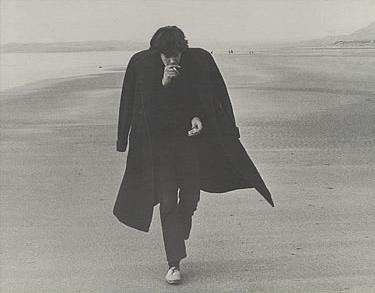
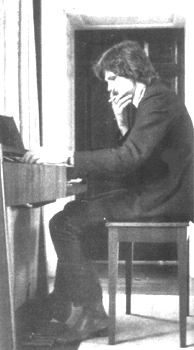
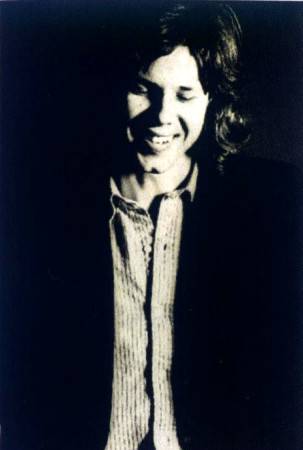
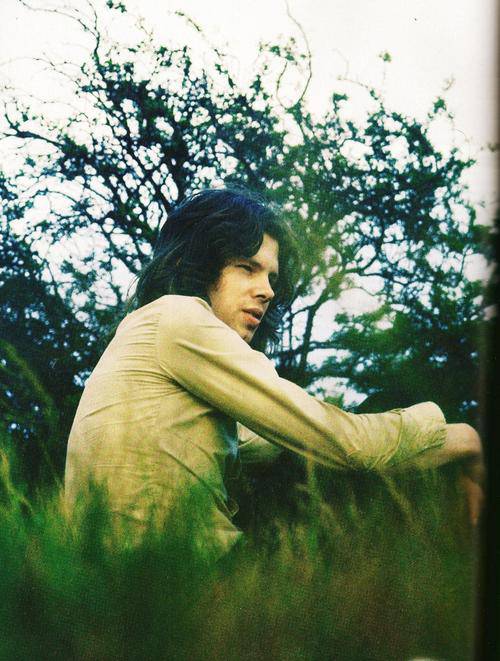
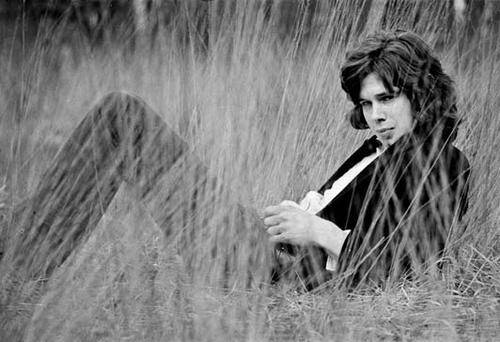
Every photograph of Nick Drake creates such aural images in my head of every song Nick wrote.....it seems that those songs are captured in these photos with each frame...all one needs is to look into the lines and curves of Nick's face & form. --JTK
So listen... and see...
Place To Be
http://www.youtube.com/watch?v=9IUqN9ozmhw


ROAD
http://www.youtube.com/watch?v=DjZMhzGkghw

If you have an image or song of Nick's you would like to share please do so....I'll certainly be back here...