The Monkees-loved by their peers and fans, MONO plays
Posted: Fri Apr 19, 2013 7:45 pm
A lengthy, but very interesting & entertaining read...enjoy.
THE MONKEES
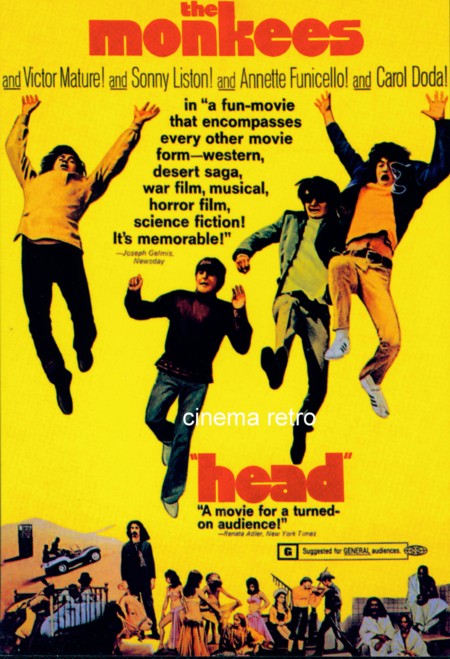
A talented bunch, doomed by their association with their cheesy show on the telly, but whose LPs revealed real talent and whose anti-movie Movie (HEAD) pretty much destroyed their career and yet solidified their legacy as one of the 60's greats. And yes they played their own instruments after their first two LPS (after a lengthy battle with Colgems ahd their producer) --& YES, they were a very talented LIVE band who always played their instruments onstage, and who had a tight power pop heavier live presence.
Listen to their first in MONO here, the way it was meant to be enjoyed, and read on...listen to Headquarters below-their first LP on which they played their own instruments.
http://www.youtube.com/watch?v=oJ8xIRwzjXQ

The Monkees were an American rock band that released music under their original incarnation between 1966 and 1970, with subsequent reunion albums and tours in the decades that followed. Assembled in Los Angeles in 1965 by Robert "Bob" Rafelson and Bert Schneider for the American television series The Monkees, which aired from 1966–1968, the musical acting quartet was composed of Americans Micky Dolenz, Michael Nesmith, and Peter Tork, and Englishman Davy Jones. The band's music was initially supervised by producer Don Kirshner.
Described by band member Micky Dolenz as initially being "a TV show about an imaginary band [...] that wanted to be The Beatles, [but] that was never successful",[1] the actor-musicians soon became a real band. As Dolenz would later describe it, "The Monkees really becoming a band was like the equivalent of Leonard Nimoy really becoming a Vulcan."[2]
For the first few months of their almost five-year initial career, the four actor-musicians were allowed only limited roles in the recording studio. This was due in part to the excessive time spent filming the TV series,[3][4] which in turn limited the amount of time available to the group to rehearse and coalesce as a band. Nonetheless, Nesmith did compose and produce some songs from the beginning, and Peter Tork contributed limited guitar work on the Nesmith-produced sessions. They soon fought for and earned the right to collectively supervise all musical output under the band's name. Although the sitcom was canceled in 1968, the band continued to record music through 1971.
In 1986, the television show experienced a revival, which led to a series of reunion tours and new records. Up until 2011, the group has reunited and toured several times, to varying degrees of success. Despite the death of Davy Jones in February 2012, the surviving members reunited for a short tour in November–December 2012.
The Monkees had a number of international hits, including "Last Train to Clarksville", "I'm a Believer", "Pleasant Valley Sunday", and "Daydream Believer". At their peak in 1967, the band outsold both the Beatles and Rolling Stones.[11] As of 2012, their albums and singles have sold over 65 million copies worldwide.
Aspiring filmmaker Bob Rafelson developed the initial idea for The Monkees in 1962, but was unsuccessful in selling the series. He had tried selling it to Revue, the television division of Universal Pictures.[3] In May 1964, while working at Screen Gems, Rafelson teamed up with Bert Schneider, whose father, Abraham Schneider, headed the Colpix Television and Screen Gems Television units of Columbia Pictures, ultimately forming Raybert Productions.[3]
The Beatles' film A Hard Day's Night inspired Rafelson and Schneider to bring Rafelson's idea for the Monkees to fulfillment. As "The Raybert Producers," they sold the show to Screen Gems Television on April 16, 1965. Rafelson's and Schneider's original idea was to cast an existing New York-based folk rock group, The Lovin' Spoonful, which was not widely known at the time. However, the canny John Sebastian had already signed the Spoonful to a record company, which would have denied Screen Gems the right to market music from the show on record.
On July 14, 1965, The Hollywood Reporter stated that future band member Davy Jones was expected to return to the United States in September 1965 after a trip to England "to prepare for [a] TV pilot for Bert Schneider and Bob Rafelson." [3] Jones had previously starred as the Artful Dodger in the Broadway show Oliver!, which began on December 17, 1962, and his performance was later seen on The Ed Sullivan Show the same night as The Beatles' first appearance on that show, February 9, 1964. He was Tony-nominated for best supporting actor in a musical in 1963.[3] In September 1964, he was signed to a long term contract to appear in TV programs for Screen Gems, make feature films for Columbia Pictures and to record music for the Colpix label.[3] Hence, Rafelson and Schneider already had him in mind for their project after their plans for the Lovin' Spoonful fell through; when they chose him, he was essentially a proto-star looking for his lucky break.
On September 8–10, 1965, Daily Variety and The Hollywood Reporter ran an ad to cast the remainder of the band/cast members for the TV show:
Madness!! Auditions. Folk & Roll Musicians-Singers for acting roles in new TV series. Running Parts for 4 insane boys, age 17-21. Want spirited Ben Frank's types. Have courage to work. Must come down for interview.
Out of 437 applicants,[5] the other three chosen for the band/cast of the TV show were Michael Nesmith, Peter Tork and Micky Dolenz. Nesmith had been a working as a musician since early 1963, and had been recording and releasing music under various names, including Michael Blessing and "Mike & John & Bill" and had studied drama in college; contrary to popular belief, of the final four, Nesmith was the one member who actually saw the ad in the Daily Variety and The Hollywood Reporter. Tork, the last to be chosen, had been working the Greenwich Village Scene as a musician, and had shared the stage with Pete Seeger; he learned of The Monkees from Stephen Stills, whom Rafelson and Schneider had rejected. Dolenz was an actor who had starred in the TV series Circus Boy as a child, using the stage name Mickey Braddock, and he had also played guitar and sung in a band called "The Missing Links" before the Monkees, which had recorded and released a very minor single, "Don't Do It." By that time, he was again using his real name of Micky Dolenz; he found out about The Monkees through his agent.
Developing the music for their debut album
During the casting process, Don Kirshner, the Screen Gems head of music, was contacted to secure music for the pilot that would become The Monkees. Not getting much interest from his usual stable of Brill Building writers, Kirshner assigned Tommy Boyce and Bobby Hart to the project.[3] The duo contributed four demo recordings that they sang on to the pilot.[3] One of these recordings was "(Theme From) The Monkees" which helped get the series the green light.[13]
When The Monkees was picked up as a series, development of the musical side of the project accelerated. Columbia-Screen Gems and RCA Records entered into a joint venture called Colgems Records primarily to distribute Monkees records.[3] Raybert set up a rehearsal space and rented instruments for the group to practice playing in April 1966,[14] but it quickly became apparent they would not be in shape in time for the series debut. The producers called upon Don Kirshner to recruit a producer for the Monkees sessions.[3]
Kirshner called on Snuff Garrett, composer of several hits by Gary Lewis & the Playboys, to produce the initial musical cuts for the show. Garrett, upon meeting the four Monkees in June 1966, decided that Jones would sing lead, a choice that was unpopular with the group. This cool reception led Kirshner to drop Garrett and buy out his contract.[3] Kirshner next allowed Nesmith to produce sessions, provided he did not play on any tracks he produced.[14] Nesmith did, however, start using the other Monkees on his sessions, particularly Tork as a guitarist.[15] Kirshner came back to the enthusiastic Boyce and Hart to be the regular producers, but he brought in one of his top east coast men, Jack Keller, to lend some production experience to the sessions.[14] Boyce and Hart observed quickly that when brought into the studio together, the four actors would fool around and try to crack each other up. Because of this, they would often bring in each singer individually.[3]
According to Nesmith, it was Dolenz's voice that made the Monkees's sound distinctive, and even during tension-filled times Nesmith and Tork sometimes turned over lead vocal duties to Dolenz on their own compositions, such as Tork's "For Pete's Sake," which became the closing title theme for the second season of the television show.
The Monkees' debut and sophomore albums were meant to be a soundtrack to the first season of the TV Show, to cash in on the audience. In the 2006 Rhino Deluxe Edition re-issue of their 2nd album, More of the Monkees, Mike Nesmith stated, "The first album shows up and I look at it with horror because it makes [us] appear as if we are a rock 'n' roll band. There's no credit for the other musicians. I go completely ballistic, and I say, 'What are you people thinking?' [The powers that be say], 'Well, you know, it's the fantasy.' I say, 'It's not the fantasy. You've crossed the line here! You are now duping the public. They know when they look at the television series that we're not a rock 'n' roll band; it's a show about a rock 'n' roll band. [...] nobody for a minute believes that we are somehow this accomplished rock 'n' roll band that got their own television show.[...] you putting the record out like this is just beyond the pale." Within a few months of their debut album, the Music Supervisor Don Kirshner would be forcibly dismissed, and the Monkees would take control as a real band.
The Monkees' first single, "Last Train to Clarksville" b/w "Take a Giant Step", was released in August 1966, just weeks prior to the TV broadcast debut. In conjunction with the first broadcast of the television show on September 12, 1966 on the NBC television network, NBC and Columbia had a major hit on their hands.[16] The first long-playing album, The Monkees, was released a month later, which spent 13 weeks at number 1, and stayed on the Billboard charts for 78 weeks. 20 years later, during their reunion, it would spend another 24 weeks on the Billboard charts. This first album is also notable, in addition to containing their debut single, for containing band member Michael Nesmith's first foray into country-rock, "Papa Gene's Blues," which mixed country, rock and Latin flavors.
From television to concert stage
The group in a publicity shot from 1967
In assigning instruments for purposes of the television show, a dilemma arose as to which of the four would be the drummer. Both Nesmith, a skilled guitarist and bassist, and Tork, who could play several stringed and keyboard instruments, were peripherally familiar with the instrument but both declined to give the drum set a try. Jones, who did know how to play drums, tested well enough initially as a drummer, but the producers felt that, behind a drum kit, the camera would exaggerate his short stature and make him virtually hidden from view. Thus, Dolenz (who only knew how to play the guitar) was assigned to become the drummer. Tork taught Dolenz his first few beats on the drums, enough for him to fake his way through filming the pilot, but Dolenz was soon taught how to play properly.[17] Thus, the lineup for the TV show most frequently featured Nesmith on guitar, Tork on bass, Dolenz on drums, and Jones as a frontman, singer, and percussionist. This, however, is in opposition to the lineup which would have made the most sense based upon the members' musical strengths. For example, Tork is actually a better guitar player than Nesmith, while Nesmith had at one time specifically trained on the bass. And while Jones certainly had a strong lead voice and sings lead on several Monkees recordings, Dolenz's voice is regarded, particularly by Nesmith, as one of the most distinctive in popular music history and a hallmark of the Monkees' sound.[18] This theoretical lineup was actually depicted once, in the music video for the band's song "Words", which shows Jones on drums, Tork playing lead guitar, Nesmith on bass and Dolenz fronting the group. In concert appearances, Tork also took much of the guitar duties, even in appearances with Nesmith, and Dolenz often plays rhythm guitar on stage.
Unlike most television shows of the time, the Monkees episodes were written with many setups, requiring frequent breaks to prepare the set and cameras for short bursts of filming. Some of the "bursts" are considered proto-music videos, in as much as they were produced to sell the records. Eric Lefcowitz, in The Monkees Tale,[19] pointed out that the Monkees were — first and foremost — a video group. The four actors would spend 12-hour days on the set, many of them waiting for the production crew to do their jobs. Noticing that their instruments were left on the set unplugged, the four decided to turn them on and start playing.[3]
After working on the set all day, the Monkees (usually Dolenz or Jones) would be called into the recording studio to cut vocal tracks. As the Monkees were essential to this aspect of the recording process, there were few limits on how long they could spend in the recording studio, and the result was an extensive catalogue of unreleased recordings.
On tour
Pleased with their initial efforts, Columbia (over Kirshner's objections) planned to send the Monkees out to play live concerts. The massive success of the series - and its spin-off records - created intense pressure to mount a touring version of the group. Against the initial wishes of the producers, Dolenz, Jones, Nesmith, and Tork went out on the road and made their debut live performance in December 1966 in Hawaii.
The band had no time to rehearse a live performance except between takes on set. They worked on the TV series all day, recorded in the studio at night, and slept very little. The weekends were usually filled with special appearances or filming of special sequences.
These performances were sometimes used during the actual series. The episode "Too Many Girls (Fern and Davy)" opens with a live version of "(I'm Not Your) Steppin' Stone" being performed as the scene was shot. One entire episode was filmed featuring live music. The last show of the premiere season, "Monkees on Tour", was shot in a documentary style by filming a concert in Phoenix, Arizona on January 21, 1967.[14] Bob Rafelson wrote and directed the episode.
In DVD commentary tracks included in the Season One release, Nesmith admitted that Tork was better at playing guitar than bass. In Tork's commentary, he stated that Jones was a good drummer and had the live performance lineups been based solely on playing ability, it should have been Tork on guitar, Nesmith on bass, and Jones on drums, with Dolenz taking the fronting role. The four Monkees performed all the instruments and vocals for most of the live set. The most notable exceptions were during each member's solo sections where, during the December 1966 – May 1967 tour, they were backed by the Candy Store Prophets. During the summer 1967 tour of the United States and the UK (from which the Live 1967 recordings are taken), they were backed by a band called The Sundowners. In 1968, the Monkees toured Australia and Japan.
The results were far better than expected. Wherever they went, the group was greeted by scenes of fan adulation reminiscent of Beatlemania. This gave the singers increased confidence in their fight for control over the musical material chosen for the series.[20]
With Jones sticking primarily to vocals and tambourine (except when filling in on the drums when Dolenz came forward to sing a lead vocal), the Monkees' live act constituted a classic power trio of electric guitar, electric bass, and drums (except when Tork passed the bass part to Jones or one of the Sundowners in order to take up the banjo or electric keyboards).
Kirshner and More of the Monkees
Andrew Sandoval noted in Rhino's 2006 Deluxe Edition CD reissue of More of the Monkees that album sales were outstripping Nielsen ratings, meaning that more people were buying the music than watching the TV Show, which meant that the producers decided that more attention needed to be paid to the music, and that more music needed to be produced for more albums. Sandoval also noted that their sophomore album, More of the Monkees, propelled by their second single, "I'm a Believer" b/w "(I’m Not Your) Steppin’ Stone", became the biggest selling LP of their career, spending 70 weeks on the Billboard charts, staying No. 1 for 18 weeks, becoming the 3rd biggest selling album of the 1960s, returning to the charts in 1986 for another 26 weeks.
At the time, songwriters Boyce and Hart considered the Monkees to be their project, with Tommy Boyce stating in the 2006 Rhino reissue of More of the Monkees that he considered the Monkees to be actors in the television show, while Boyce & Hart were the songwriters and producers doing the records. They wanted Micky to sing the faster songs, and have Davy sing the ballads. He also stated in the liner notes that he felt that Michael's country leanings didn't fit in with The Monkees' image, and although he thought that Peter was a great musician, he thought that Peter had a different process of thinking about songs that wasn't right for The Monkees. Music Coordinator Kirshner, though, realizing how important the music was, wanted to move the music in a newer direction than Boyce/Hart to get the best record, and so he decided to move the production to New York. where his A-list of writers/producers resided.
However, The Monkees had been complaining that the music publishing company would not allow them to play their own instruments on their records, or to use more of their own material. These complaints intensified when Kirshner moved track recording from California to New York, leaving the Monkees out of the musical process until they were called upon to add their vocals to the completed tracks. This campaign eventually forced Don Kirshner to let the group have more participation in the recording process. Dolenz's initial reaction, mentioned in the 2006 Rhino CD reissue of More of the Monkees, was "To me, these were the soundtrack albums to the show, and it wasn't my job. My job was to be an actor and to come in and to sing the stuff when I was asked to do so. I had no problem with that [...] It wasn't until Mike and Peter started getting so upset that Davy and I started defending them [...] they were upset because it wasn't the way they were used to making music. The artist is the bottom line. The artist decides what songs are gonna go on and in what order and who writes 'em and who produces 'em." Nesmith, when asked the situation in Rolling Stone said, "[...] We were confused, especially me. But all of us shared the desire to play the songs we were singing. Everyone was accomplished – the notion I was the only musician is one of those rumors that got started and won't stop – but it was not true. [...] We were also kids with our own taste in music and were happier performing songs we liked – and/or wrote – than songs that were handed to us.[...] The [TV show's] producers [in Hollywood] backed us and David went along. None of us could have fought the battles we did [with the music publishers] without the explicit support of the show's producers."[21]
Four months after their debut single was released in September 1966, on January 16, 1967, the Monkees held their first recording session as a fully functioning, self-contained band, recording an early version of band member Nesmith's self-composed top 40 hit single "The Girl I Knew Somewhere", along with "All of Your Toys" and "She's So Far Out, She's In".[3] 4 days later, on January 20, 1967, their debut self-titled album made its belated release in the U.K.[14] (it was released in October '66 in the U.S.). This same month, Kirshner released their second album of songs that used session musicians, More of the Monkees, without the band's knowledge. Nesmith and Tork were particularly upset when they were on tour in January 1967 and discovered this second album. The Monkees were annoyed at not having even been told of the release in advance, at having their opinions on the track selection ignored, at Don Kirshner's self-congratulatory liner notes, and also because of the amateurish-looking cover art, which was merely a composite of pictures of the four taken for a J. C. Penney clothing advertisement. Indeed, the Monkees had not even been given a copy of the album; they had to buy it from a record store.[22]
The climax of the rivalry between Kirshner and the band was an intense argument between Nesmith, Kirshner, and Colgems lawyer Herb Moelis, which took place at the Beverly Hills Hotel in January 1967. Kirshner had presented the group with royalty checks and gold records. Nesmith had responded with an ultimatum, demanding a change in the way the Monkees' music was chosen and recorded. Moelis reminded Nesmith that he was under contract. The confrontation ended with Nesmith punching a hole in a wall and saying, "That could have been your face!" However, each of the members, including Nesmith, accepted the $250,000 royalty checks (equivalent to approximately $1,700,000 in today's funds[23]).[22]
Kirshner's dismissal came in early February 1967, when he violated an agreement between Colgems and the Monkees not to release material directly created by the group together with unrelated Kirshner-produced material. Kirshner violated this agreement when he released the "A Little Bit Me, A Little Bit You", composed and written by Neil Diamond, as a single with an early version of "She Hangs Out", a song recorded in New York with Davy Jones' vocals, as the B-side. This single would be withdrawn.[24]
Kirshner was reported to have been incensed by the group's unexpected rebellion, especially when he felt they had "modicum talent" when compared to the superstars of the day like Lennon/McCartney.[22] In the liner notes for Rhino's 2006 Deluxe Edition CD reissue of More of the Monkees, Kirshner stated, " because I had a contract. I kicked them out of the studio because I had a TV show that I had to put songs in, and to me it was a business and I had to knock off the songs." This experience led directly to Kirshner's later venture, The Archies, which was an animated series – the "stars" existed only on animation cels, with music done by studio musicians, and obviously could not seize creative control over the records issued under their name.
Screen Gems held the publishing rights to a wealth of great material, with the Monkees given first crack at many new songs. Due to the abundance of songs, The Monkees left a lot of songs unreleased until Rhino Records started releasing them through the Missing Links series of albums, starting in the late 1980s. The Monkees were even rumored to have turned down "Sugar, Sugar" in 1967. The selection became one of the biggest hits of 1969 when recorded by The Archies, featuring Ron Dante on lead vocals. But in the late 1990s, producer and songwriter Jeff Barry, who had jointly written and composed "Sugar, Sugar" with Andy Kim, denied that the Monkees had been offered the selection, saying that it had not even been written or composed at the time.[citation needed]
"Here, I'm going to make you a big star ... and you don't have to pay any dues. ... For that, you're going to get no respect from your contemporaries." ... To me, that was the cruelest thing. [16]
Phil Spector, 1968 Pop Chronicles interview.
Independence
Headquarters and Pisces, Aquarius, Capricorn & Jones
On January 16, 1967, four months after their public debut, the Monkees held their first recording session as a fully functioning, self-contained band at RCA Recording Studios, Hollywood, CA, recording an early version of band member Nesmith's self-composed top 40 hit single "The Girl I Knew Somewhere", along with "All of Your Toys" and "She's So Far Out, She's In".[3] The Monkees wanted to pick the songs they sang, and play on the songs they recorded, and be The Monkees. By the end of February 1967, with Kirshner dismissed as Musical Supervisor, Michael Nesmith hired Douglas Farthing Hatlelid, who was better known, by his stage name of Chip Douglas, as former bassist of "The Turtles," to produce the next Monkees album,[22] which was to be the first Monkees album where they were the only musicians, outside of most of the bass, and the horns. Douglas was responsible for both music presentation-—actually leading the band and engineering recordings—and playing bass on most of Headquarters. This album, along with their next, Pisces, Aquarius, Capricorn & Jones Ltd. would serve as the soundtrack to the 2nd season of the TV Show.
In March 1967, "The Girl I Knew Somewhere", composed by Nesmith, and performed by Dolenz, Nesmith, Tork & bassist John London, was issued as the B-side to The Monkees' 3rd single, "A Little Bit Me, A Little Bit You", and it rose to No. 39 on the charts. The A-side rose to No. 2.[3]
Issued in May 1967, the album Headquarters had no songs released as singles in the United States, but it would still be their third No. 1 album in a row, with many of its songs played on the 2nd season of the TV Show. Having a more country-folk-rock sound than the pop outings under Kirshner, Sandoval notes in the 2007 Deluxe Edition reissue from Rhino that the album rose to No. 1 on June 24, 1967, with The Beatles' Sgt. Pepper released the following week, which would knock Headquarters to the number 2 spot on the charts for the next 11 weeks, the "Summer of Love". A selection that Dolenz wrote and composed, "Randy Scouse Git," was issued under the title "Alternate Title" (due to the controversial title of the song) as a single internationally, where it rose to No. 2 on the charts in the U.K and Norway, and in the top 10 in other parts of the world.[3] Peter Tork's "For Pete's Sake" would be used as the closing theme for the TV show. Michael Nesmith would continue in his country-rock leanings, adding the pedal steel guitar to 3 of the songs, along with contributing his self-composed countrified-rock song "Sunny Girlfriend". Tork added the banjo to the Nesmith composed rocker "You Told Me", a song whose introduction was satirical of The Beatles' "Taxman".[3] Other notable songs are the Nesmith composed straight forward pop-rock song "You Just May Be the One", used on the TV series during both seasons, along with "Shades of Gray" (with piano introduction written by Tork [3]), "Forget that Girl" and "No Time", used in the TV show. The Monkees wrote 5 of the 12 songs on the album, plus the two tracks "Band 6" and "Zilch". The Los Angeles Times, when reviewing Headquarters, stated that "The Monkees Upgrade Album Quality" and that "The Monkees are getting better. Headquarters has more interesting songs and a better quality level [than previous albums]...None of the tracks is a throwaway[...] The improvement trend is laudable." [3]
The high of Headquarters was short-lived, however. Recording and producing as a group was Tork's major interest and he hoped that the four would continue working together as a band on future recordings according to the liner notes of the 2007 Rhino reissue of Pisces, Aquarius, Capricorn & Jones Ltd.. "Cuddly Toy" on Pisces, Aquarius, Capricorn & Jones Ltd. would mark the last time Dolenz, who originally played guitar before The Monkees, would make a solo stand as a studio drummer.[25] In commentary for the DVD release of the second season of the show, Tork said that Dolenz was "incapable of repeating a triumph." Having been a drummer for one album, Dolenz lost interest in being a drummer, and indeed, he largely gave up playing instruments on Monkees recordings. (Producer Chip Douglas also had identified Dolenz's drumming as the weak point in the collective musicianship of the quartet, having to splice together multiple takes of Dolenz's "shaky" drumming for final use.) By this point, the four did not have a common vision regarding their musical interests, with Nesmith and Jones also moving in different directions, with Nesmith following his country/folk instincts and Jones reaching for Broadway-style numbers.
The next three albums featured a diverse mixture of musical style influences, including country-rock, folk-rock, psychedelic rock, soul/R&B, guitar rock, Broadway, and English music hall sensibilities.
At the height of their fame in 1967, they also suffered from a media backlash. Nesmith states in the 2007 Rhino reissue of Pisces, Aquarius, Capricorn & Jones Ltd., "Everybody in the press and in the hippie movement had got us into their target window as being illegitimate and not worthy of consideration as a musical force [or] certainly any kind of cultural force. We were under siege; wherever we went there was such resentment for us. We were constantly mocked and humiliated by the press. We were really gettin' beat up pretty good. We all knew what was going on inside. Kirshner had been purged. We'd gone to try to make Headquarters and found out that it was only marginally okay and that our better move was to just go back to the original songwriting and song-making strategy of the first albums except with a clear indication of how [the music] came to be [...] The rabid element and the hatred that was engendered is almost impossible to describe. It lingers to this day among people my own age." Tork disagreed with Nesmith's assessment of Headquarters stating, "I don't think the Pisces album was as groovy to listen to as Headquarters. Technically it was much better, but I think it suffers for that reason." [3] Both Headquarters and Pisces are highly revered by most Monkees fans.
With Pisces, Aquarius, Capricorn & Jones Ltd., The Monkees fourth album, they went back to making music for the TV Show, except that they had control over the music, and which songs would be chosen. They used a mixture of themselves and session musicians on the album. They would use this strategy of themselves playing, plus adding session musicians (including The Wrecking Crew, Louie Shelton, Glen Campbell, members of the Byrds and the Association, drummer "Fast" Eddie Hoh, Lowell George, Stephen Stills, Buddy Miles and Neil Young) throughout their recording career, relying more on session musicians when the group became temporarily estranged after Pisces, Aquarius, Capricorn & Jones Ltd. and recorded some of their songs separately.
Using Chip Douglas again to produce, Pisces, Aquarius, Capricorn & Jones Ltd., released in November 1967 [3] was The Monkees fourth No. 1 album in a row, staying at No. 1 for 5 weeks,[26] and was also their last No. 1 album. It featured the hit single "Pleasant Valley Sunday" (#3 on charts) b/w "Words" (#11 on charts), which the A-side had Nesmith on electric guitar/backing vocals, Tork on piano/backing vocals, Dolenz on lead vocals and possibly guitar, and Jones on backing vocals;[3] the B-side had Micky and Peter alternating lead vocals, Peter played organ, Mike played guitar, percussion & provided backing vocals, and Davy provided percussion and backing vocals.[3] Other notable items about this album is that it features an early use of the Moog Synthesizer on two tracks, the Nesmith-penned "Daily Nightly", along with "Star Collector". All of its songs, except for two, were featured on the Monkees' TV show during the second season.
Recorded in June 1967, the song "What Am I Doing Hangin' 'Round?", featured on Pisces, Aquarius, Capricorn & Jones Ltd. is seen as a landmark in the fusion of country and rock [3] despite Nesmith's prior country-flavored rock songs for The Monkees. Nesmith stated, "One of the things that I really felt was honest was country-rock. I wanted to move The Monkees more into that because [...] if we get closer to country music, we'll get closer to blues, and country blues, and so forth. [...] It had a lot of un-country things in it: a familiar change from a I major to a VI minor--those kinds of things. So it was a little kind of a new wave country song. It didn't sound like the country songs of the time, which was Buck Owens." [3]
Their next single, "Daydream Believer" (with a piano intro written by Tork), would shoot to No. 1 on the charts, letting The Monkees hold the No. 1 position in the singles chart and the album chart with Pisces simultaneously.[3] "Daydream Believer" used the non-album track "Goin’ Down" as its B-side, which featured Nesmith & Tork on guitar with Micky on lead vocals.
During their 1986 reunion, both Headquarters and Pisces, Aquarius, Capricorn & Jones Ltd. would return to the charts for 17 weeks.[27]
[edit] The Birds, The Bees & The Monkees
The Monkees decided that they no longer needed Chip Douglas as a producer, and starting in November 1967, they largely produced their own sessions.[3] Although The Monkees albums after this date will state "Produced by The Monkees", they would mostly be recording as solo artists.[3] In a couple of cases, Boyce & Hart had returned from the first two albums to produce, but credit was given to The Monkees.[3] It was also during this time that Michael Nesmith recorded his first solo album, The Wichita Train Whistle Sings, a big band jazz instrumental collection of interpretations of Nesmith's compositions, arranged by the jazz musician, Shorty Rogers. Praised in The Los Angeles Times by the author of The Encyclopedia of Jazz, jazz critic Leonard Feather would state, "Verbally and musically, Mike Nesmith is one of the most articulate spokesmen for the new and literate breed of pop musicians who have spring from the loins of primitive rock. [The album] with its carriage trade of symphony, rock, country, western, and swing, and with jazz riding in the caboose, may well indicate where contemporary popular music will be situated in the early 1970s." [3]
Considered by some to be The Monkees' "White Album" period (for example, Sandoval mentions this in the liner notes of Rhino Handmade's 2010 Deluxe reissue of the album), each of the Monkee's contributions reflected that individual's own musical tastes, which resulted in an eclectic album. Micky sang the pop songs (e.g. "I'll Be Back Upon My Feet"), and performed a double-vocal with Mike on the Nesmith/Allison composed "Auntie's Municipal Court". Davy sang the ballads (e.g. "Daydream Believer" and "We Were Made for Each Other") and Nesmith contributed some experimental songs, like the progressive "Writing Wrongs", the unusual hit song "Tapioca Tundra", and the lo-fi 1920s sound of "Magnolia Simms". This last song is notable for added effects to make it sound like an old record (even including a "record skipping" simulation) made before The Beatles "Honey Pie", which used a similar effect.
Propelled by the hit singles "Daydream Believer" and "Valleri", along with Nesmith's self-penned top 40 hit "Tapioca Tundra", The Birds, The Bees & The Monkees reached No. 3 on the Billboard charts shortly after it was released in April 1968.[3] It was the first album released after NBC announced they were not renewing The Monkees for a third season. The album cover—a quaint collage of items looking like a display in a jumble shop or toy store—was chosen over the Monkees' objections. It was the last Monkees' album to be released in separate, dedicated mono and stereo mixes.[3] During the 1986 reunion, it would return to the Billboard charts for 11 weeks.[27]
Beyond television
This section needs additional citations for verification. Please help improve this article by adding citations to reliable sources. Unsourced material may be challenged and removed. (March 2012)
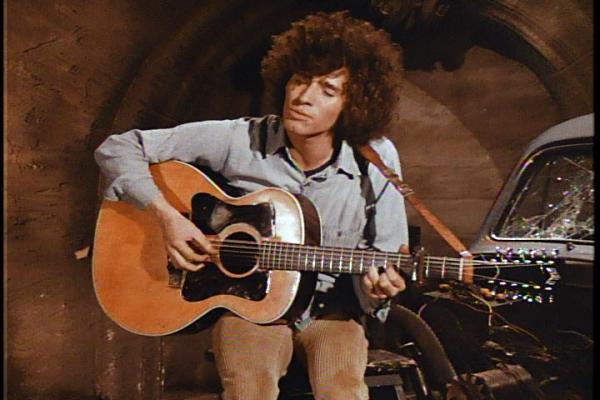
During the filming of the second season, the band became tired of scripts which they deemed monotonous and stale. They had already succeeded in eliminating the laugh track (a then-standard on American sitcoms), with the bulk of Season 2 episodes airing minus the canned chuckles. They proposed switching the format of the series to become more like a variety show, with musical guests and live performances. This desire was partially fulfilled within some second-season episodes, with guest stars like musicians Frank Zappa, Tim Buckley and Charlie Smalls (composer of The Wiz) performing on the show. However, NBC was not interested in eliminating the existing format, and the group (except for Peter) had little desire to continue for a third season. Tork said in DVD commentary that everyone had developed such difficult personalities that the big-name stars invited as guests on the show would invariably leave the experience "hating everybody".
Screen Gems and NBC went ahead with the existing format anyway, commissioning Monkees writers Gerald Gardner and Dee Caruso to create a straight-comedy, no-music half-hour in the Monkees mold; a pilot episode was filmed with the then-popular nightclub act The Pickle Brothers. The pilot had the same energy and pace of The Monkees, but never became a series.
In June 1968, Music Supervisor Lester Sill chose to release the two non-album tracks "D.W. Washburn" b/w "It's Nice To Be With You" as The Monkees' next single.[3] The Leiber/Stoller-penned A-side would break into the Top 20, peaking at No. 19 on the charts.[28]
Head
After The Monkees was canceled in February 1968, Rafelson directed the four Monkees in a feature film, Head. Schneider was executive producer, and the project was co-written and co-produced by Bob Rafelson with a then relatively unknown Jack Nicholson.
The film, conceived and edited in a stream of consciousness style, featured oddball cameo appearances by movie stars Victor Mature, Annette Funicello, a young Teri Garr, boxer Sonny Liston, famous stripper Carol Doda, Green Bay Packer linebacker Ray Nitschke, and musician Frank Zappa. It was filmed at Columbia Pictures' Screen Gems studios and on location in California, Utah, and The Bahamas between February 19 and May 17, 1968 and premiered in New York City on November 6 of that year (the film later debuted in Hollywood on November 20).
The film was not a commercial success, in part because it was the antithesis of The Monkees television show, intended to comprehensively demolish the group's carefully groomed public image. Rafelson and Nicholson's Ditty Diego-War Chant (recited at the start of the film by the Monkees), ruthlessly parodies Boyce and Hart's "Monkees Theme". A sparse advertising campaign (with no mention of the Monkees) squelched any chances of the film doing well, and it played only briefly. In commentary for the DVD release, Nesmith said that by this time, everyone associated with the Monkees "had gone crazy". They were each using the platform of the Monkees to push their own disparate career goals, to the detriment of the Monkees project. Indeed, Nesmith said, Head was Rafelson and Nicholson's intentional effort to "kill" the Monkees, so that they would no longer be bothered with the matter.
Released in October 1968, the single from the album, "The Porpoise Song", is a psychedelic pop song written by Goffin/King, with vocals from Micky Dolenz and Davy Jones, and it reached number 62 on the Billboard charts.[3]
The soundtrack album to the movie, Head reached No. 45 on the Billboard charts.[3] Jack Nicholson assembled the film's soundtrack album, weaving dialogue and sound effects from the film in-between the songs from the film. The six (plus "Ditty Diego") Monkees songs on the album range from psychedelic pop to straight ahead rockers to Broadway rock to eastern-influenced pop to a folk-rock ballad. Although The Monkees performed "Circle Sky" live in the film, the studio version is chosen for the soundtrack album. The live version would later be released on various compilations, including Rhino's Missing Links series of Monkees albums. The soundtrack album also includes a song from the film's composer, Ken Thorne. The album had a mylar cover, to give it a mirror-like appearance, so that the person looking at the cover would see their own head, a play on the album title Head. Peter Tork said, "That was something special[...] [Jack] Nicholson coordinated the record, made it up from the soundtrack. He made it different from the movie. There's a line in the movie where [Frank] Zappa says, 'That's pretty white.' Then there's another line in the movie that was not juxtaposed in the movie, but Nicholson put them together in the [soundtrack album], when Mike says, 'And the same thing goes for Christmas.' [...] that's funny, [...] very different from the movie [...]that was very important and wonderful that he assembled the record differently from the movie. [...] It was a different artistic experience." [3] The soundtrack album is a cult favorite among the Monkees' fans.
Over the intervening years Head has developed a cult following for its innovative style and anarchic humor. Members of the Monkees, Nesmith in particular, cite the soundtrack album as one of the crowning achievements of the band.
Early 1969: Tork's resignation, Instant Replay and The Monkees Present
Tensions within the group were increasing. Peter Tork, citing exhaustion, quit by buying out the last four years of his Monkees contract at $150,000/year, equal to about $940,000 per year today. This was shortly after the band's Far East tour in December 1968, after completing work on their 1969 NBC television special, 33 1/3 Revolutions Per Monkee, which rehashed many of the ideas from Head, only with the Monkees playing a strangely second-string role. In the DVD commentary for the television special, Dolenz noted that after filming was complete, Nesmith gave Tork a gold watch as a going-away present, engraved "From the guys down at work." (Tork kept the back, but replaced the watch several times in later years.) Most of the songs from the 33 1/3 Revolutions Per Monkee TV Special would not be officially released until over 40 years later, on the 2010 & 2011 Rhino Handmade Deluxe box sets of Head and Instant Replay.
Since The Monkees at this point were producing their own songs with very little of the other band members involvement, they planned a future double album (eventually to be reduced to The Monkees Present) on which each Monkee would separately produce one side of a disc.
In February 1969, The Monkees 7th album, Instant Replay, without Tork's involvement beyond playing guitar on "I Won't Be the Same Without Her," was released, which reached No. 32 on the charts.[3] The single from the album was "Tear Drop City", which peaked at No. 56 on the US Billboard chart and No. 34 on the Australian chart.[3] According to Rhino Handmade's 2011 Deluxe Edition reissue of this album, Davy Jones told Melody Maker, "Half of the songs were recorded over the last three years, but there are also about six new ones." The Monkees wanted to please the original 1966 fans by offering up new recordings of some previously unreleased older styled songs, as well as gain a new audience with what they considered a more mature sound. Nesmith continued in his country-rock vein after offering straight ahead rock and experimental songs on the two prior albums. Nesmith stated in Rhino Handmade's 2011 Deluxe Edition reissue, "I guess it was the same embryo beating in me that was somewhere in Don Henley and Glenn Frey and Linda Ronstadt and Neil Young. Everybody who was hanging out in those times. I could just feel this happening that there was this thing. So, I headed off to Nashville to see if I couldn't get some of the Nashville country thing into the rock 'n' roll or vice versa. What I found was that Nashville country was not the country that was going to be the basis of country-rock and that it was Western, Southwest country. It was coming much more out of the Southern California scene. I ended up with a lot of Dobro, mandolin, banjo, and things that were hard-core mountain music stuff [...] the Nashville cats were so blown out by playin' this kind of music. They loved it, for one thing." Dolenz contributed The Monkees biggest and longest Monkees' production, "Shorty Blackwell," a song inspired by his cat of the same name.[3] Dolenz called it his "feeble attempt at something to do with Sgt. Pepper." [3] Jones contributed an electric guitar rocker, "You and I." Both Jones and Dolenz continued their role of singing on the pop songs. Lyrically, it has a theme of being one of the Monkees' most melancholy albums.
Throughout 1969 the trio appeared as guests on television programs such as The Glen Campbell Goodtime Hour, The Johnny Cash Show, Hollywood Squares, and Laugh-In. The Monkees also had a contractual obligation to appear in several television commercials with Bugs Bunny for Kool-Aid drink mix as well as Post cereal box singles.
In April 1969, the single "Someday Man" b/w "Listen to the Band" was released,[3] which had the unique distinction of the B-side, the Nesmith composed country-rock song "Listen to the Band" charting higher (#63) than the Davy sung A-side (#81).[3][28]
The final album with Michael Nesmith from The Monkees original incarnation would be their 8th album, The Monkees Present, released in October 1969, which peaked at No. 100 on the Billboard charts.[3] It would include the Nesmith composed country-rock singles "Listen to the Band" and "Good Clean Fun" (released in September 1969).[3] Other notable songs include the Dolenz composition "Little Girl", which featured Louie Shelton on electric guitar, joining Micky on acoustic guitar,[3] along with his controversial "Mommy and Daddy" (B-side to the "Good Clean Fun single) in which he sang about America's treatment of the Native Americans and drug abuse, and in an earlier take, released on Rhino Handmade's 2011 Deluxe Edition of Instant Replay, sang about JFK's assassination and the Vietnam war. Jones collaborated with Bill Chadwick on some slower ballads, along with releasing a couple of older upbeat songs from 1966.
In the summer of 1969 the three Monkees embarked on a tour with the backing of the soul band "Sam and the Good-Timers". The concerts for this tour were longer sets than their earlier concert tours, many shows running over two hours. The 1969 Monkees' tour was not all that successful; some shows were canceled due to poor ticket sales.
April 1970: Nesmith's resignation and Changes
On April 14, 1970, Nesmith joined Micky and Davy for the possibly the last time as part of the original incarnation of The Monkees to film a Kool-Aid commercial,[3] with Nesmith leaving the group to continue recording songs with his own country-rock group called Michael Nesmith & The First National Band, which he had started recording with on February 10, 1970.[3] His first album with his own band was called Magnetic South, and at the time he left The Monkees in April, he was recording songs for his second album with The First National Band, called Loose Salute.
This left Micky and Davy to record the bubblegum pop album Changes as the ninth and final album by The Monkees released during its original incaranation. By this time, Colgems was hardly putting any effort into the project, and they sent Dolenz and Jones to New York for the Changes sessions, to be produced by Jeff Barry and Andy Kim. In comments for the liner notes of the 1994 re-release of Changes, Jones said that he felt they had been tricked into recording an "Andy Kim album" under the Monkees name. Except for the two singers' vocal performances, Changes is the only album that fails to win any significant praise from critics looking back 40 years to the Monkees' recording output. The album spawned the single "Oh My My", which was accompanied by a music film promo (produced/directed by Micky). It's also notable that Micky Dolenz contributed one of his own compositions, "Midnight Train", which was used in the re-runs of the Monkees TV series. The "Oh My My" b/w "I Love You Better" single from the Changes album would be the last single issued under the Monkees name in the United States.[3] Originally released in June 1970,[3] Changes would first chart in Billboard's Top 200 during the Monkees' 1986 reunion, staying on the charts for 4 weeks.[29]
September 22, 1970 marked the final recording session by The Monkees in their original incarnation, when Davy Jones and Micky Dolenz recorded "Do It In The Name of Love" and "Lady Jane".[3] Not mixed until February 19, 1971, and released later that year as a single ("Do It In The Name Of Love" b/w "Lady Jane"),[14] the two remaining Monkees then lost the rights to use the name in several countries, the U.S. included. The single was not credited to the Monkees in the U.S., but to a misspelled "Mickey Dolenz and Davy Jones",[14] although some other countries would issue the single under The Monkees' name.
Davy Jones would release a solo album in 1971, entitled Davy Jones, featuring the single "Rainy Jane" / "Welcome to My Love". Both Davy and Micky would release multiple singles as solo artists in the years following the original break-up of The Monkees. The duo continued to tour throughout most of the 1970s.
Reunions and Revivals
Dolenz, Jones, Boyce & Hart
Partly because of repeats of the television seriesThe Monkees on Saturday mornings and in syndication, The Monkees Greatest Hits charted in 1976. The LP, issued by Arista, who by this time had custody of the Monkees’ master tapes, courtesy of their corporate owner, Screen Gems, was actually a re-packaging of an earlier (1972) compilation LP called Refocus that had been issued by Arista's previous label imprint, Bell Records, also owned by Screen Gems. Dolenz and Jones took advantage of this, joining ex-Monkees songwriters Tommy Boyce and Bobby Hart to tour the United States. From 1975 to 1977, as the "Golden Hits of The Monkees" show ("The Guys who Wrote 'Em and the Guys who Sang 'Em!"), they successfully performed in smaller venues such as state fairs and amusement parks, as well as making stops in Japan, Thailand, Hong Kong and Singapore. They also released an album of new material as Dolenz, Jones, Boyce & Hart. Nesmith had not been interested in a reunion. Tork claimed later that he had not been asked, although a Christmas single (credited to Micky Dolenz, Davy Jones and Peter Tork due to legal reasons) was produced by Chip Douglas and released on his own label in 1976. The single featured Douglas' and Howard Kaylan's "Christmas Is My Time Of Year" (originally recorded by a 1960s supergroup, Christmas Spirit), with a B-side of Irving Berlin's "White Christmas" (Douglas released a remixed version of the single, with additional overdubbed instruments, in 1986). This was the first (albeit unofficial) Monkees single since 1971. Tork also joined Dolenz, Jones, Boyce & Hart on stage at Disneyland on July 4, 1976, and also joined Dolenz and Jones on stage at the Starwood in Hollywood, California in 1977.
Other semi-reunions occurred between 1970 and 1986. Peter Tork helped arrange a Micky Dolenz single, "Easy on You"/"Oh Someone" in 1971. Tork also recorded some unreleased tracks for Nesmith's Countryside label during the 1970s, and Dolenz (by then a successful television director in the United Kingdom) directed a segment of Nesmith's NBC-TV series Television Parts, although the segment in question was not included when the series' six episodes aired during the summer of 1985.
MTV and Nickelodeon reignite Monkeemania
Brushed off by critics during their heyday as manufactured and lacking talent, The Monkees experienced a critical and commercial rehabilitation two decades later. A Monkees TV show marathon ("Pleasant Valley Sunday") was broadcast on February 23, 1986, on the then five-year-old MTV video music channel. In February and March, Tork and Jones played together in Australia. Then in May, Dolenz, Jones, and Tork announced a "20th Anniversary Tour" produced by David Fishof and they began playing North America in June with Dolenz. Their original albums began selling again as Nickelodeon began to run their old series daily. MTV promotion also helped to resurrect a smaller version of Monkeemania, and tour dates grew from smaller to larger venues and became one of the biggest live acts of 1986 and 1987. A new greatest hits collection was issued reaching platinum status.
By now, Nesmith was amenable to a reunion, but forced to sit out most projects because of prior commitments to his bustling Pacific Arts video production company. However, he did appear with the band in a 1986 Christmas medley music video for MTV, and appeared on stage with Dolenz, Jones, and Tork at the Greek Theatre, in Los Angeles, on September 7, 1986. In September 1988, the three rejoined to play Australia again, Europe and then North America, with that string of tours ending in September 1989. Mike again returned at the Universal Amphitheatre, Los Angeles, show on July 10, 1989 and took part in a dedication ceremony at the Hollywood Walk of Fame, when the Monkees received a TV star there in 1989.
The sudden revival of the Monkees in 1986 helped move the first official Monkees single since 1971, "That Was Then, This Is Now", to the No. 20 position in Billboard Magazine. The success, however, was not without controversy. Davy Jones had declined to sing on the track, recorded along with two other new songs included in a compilation album, Then & Now... The Best of The Monkees. Some copies of the single and album credit the new songs to "the Monkees", others as "Micky Dolenz and Peter Tork (of the Monkees)". Reportedly, these recordings were the source of some personal friction between Jones and the others during the 1986 tour; Jones would typically leave the stage when the new songs were performed.
Of note is that the 1980s Reunion tours had been the most lucrative venture the three had ever seen in their days as a Monkee, far surpassing the monies they had made in the 1960s. Mike had little financial need to join in Monkees-related projects, mostly as his mother Bette Nesmith Graham was the inventor of Liquid Paper, leaving Nesmith over $25 million upon her death in 1980.
A new album by the touring trio, Pool It! (the Monkees' 10th), appeared the following year and was a moderate success. From 1986 to 1989, the Monkees would conduct major concert tours in the United States, Australia, Japan, and Europe.
New Monkees
Main article: New Monkees
In 1987, a new television series called New Monkees appeared. Four young musicians were placed in a similar series based on the original show, but "updated" for the 1980s. The New Monkees left the air after 13 episodes. (Neither Bob Rafelson nor Bert Schneider were involved in the development or production of the series, although it was produced by "Straybert Productions" headed by Steve Blauner, Rafelson and Schneider's partner in BBS Productions.)
[edit] 1990s reunions
In the 1990s, the Monkees continued to record new material. In 1993, Dolenz and Jones worked together on a television commercial, and another reunion tour was launched with the two of them in 1994. Perhaps the greatest reunion of sorts was released by Rhino Records re-issuing all the original LPs on CD, each of which included between three to six bonus tracks of previously unreleased or alternate takes; the first editions came with collectible trading cards.
Their 11th album Justus was released in 1996. It was the first since 1968 on which all four original members performed and produced. Justus was produced by the Monkees, all songs were written by one of the four Monkees, and it was recorded using only the four Monkees for all instruments and vocals, which was the inspiration for the album title and spelling (Justus = Just Us).
The trio of Dolenz, Jones, and Tork reunited again for a successful 30th anniversary tour of American amphitheaters in 1996, while Nesmith joined them onstage in Los Angeles to promote the new songs from Justus. For the first time since the brief 1986 reunion, Nesmith returned to the concert stage for a tour of the United Kingdom in 1997, highlighted by two sold-out concerts at Wembley Arena in London. The full quartet also appeared in an ABC television special titled Hey, Hey, It's the Monkees, which was written and directed by Nesmith and spoofed the original series that had made them famous. Nevertheless, following the UK tour, Nesmith declined to continue future performances with the Monkees, having faced harsh criticism from the British music press for his deteriorating musicianship. Tork noted in DVD commentary that "In 1966, Nesmith had learned a reasonably good version of the famous 'Last Train to Clarksville' guitar lick, but in 1996, Mike was no longer able to play it" and so Tork took over the lead guitar parts.
Nesmith's departure from the tour was acrimonious. Jones was quoted by the Los Angeles Times as complaining that Nesmith "made a new album with us. He toured Great Britain with us. Then all of a sudden, he's not here. Later, I hear rumors he's writing a script for our next movie. Oh, really? That's bloody news to me. He's always been this aloof, inaccessible person...the fourth part of the jigsaw puzzle that never quite fit in."[30]
2000s reunions
Tork, Jones, and Dolenz toured the United States in 1997, after which the group took another hiatus until 2001 when they once again reunited to tour the United States. However, this tour was also accompanied by public sniping. Dolenz and Jones had announced that they had "fired" Tork for his constant complaining and threatening to quit. Tork was quoted as saying that, as well as the fact he wanted to tour with his own band, "Shoe Suede Blues." Tork told WENN News he was troubled by the overindulgence in alcohol by other members of the tour crew:
"Micky Dolenz and Davy Jones fired me just before the last two shows of our 35th anniversary tour. I'm both happy and sad over the whole thing. I always loved the work onstage—but I just couldn't handle the backstage problems. I'd given them 30 days notice that I was leaving so my position is that I resigned first and then they dropped me. Thank God I don't need the Monkees anymore...I'm a recovering alcoholic and haven't had a drink in several years. I'm not against people drinking—just when they get mean and abusive. I went on the anniversary tour with the agreement that I didn't have to put up with drinking and difficult behavior offstage. When things weren't getting better, I gave the guys notice that I was leaving in 30 days for good."[31]
Tork later stated in 2011 that the alcohol played only a small role and Tork then said, "I take full responsibility for the backstage problems on the 2001 tour. We were getting along pretty well until I had a meltdown. I ticked the other guys off good and proper and it was a serious mistake on my part. I was not in charge of myself to the best of my ability – the way I hope I have become since. I really just behaved inappropriately, honestly. I apologized to them." [32]
Jones and Dolenz went on to tour the United Kingdom in 2002, but Tork declined to participate. Jones and Dolenz toured the United States one more time as a duo in 2002, and then split to concentrate on their own individual projects. With different Monkees citing different reasons, the group chose not to mark their 40th anniversary in 2006.
2010–2011 reunions
In October, Jones stated that a reunion marking the band's 45th anniversary was a possibility.[33] Noted Monkees biographer Andrew Sandoval commented in The Hollywood Reporter that he "spent three years cajoling them to look beyond their recent differences (which included putting aside solo projects to fully commit to The Monkees)."[5]
An Evening with The Monkees: The 45th Anniversary Tour commenced on May 12, 2011 in Liverpool, England,[34] before moving to North America in June and July for a total of 43 performances.[35] Sandoval noted, "Their mixed feelings on the music business and their long and winding relationship weighed heavily, but once they hit the stage, the old magic was apparent. For the next three months...[they brought] the music and memories to fans in the band's grandest stage show in decades. Images from their series and films flashed on a huge screen behind them; even Rolling Stone, whose owner, Jann Wenner, has vowed to keep them out of the Rock and Roll Hall of Fame, gushed."[5] Nesmith did not take part in the tour, which grossed approximately $4 million.[36]
On August 8, 2011, the band cancelled ten last-minute shows due to what was initially reported as "internal group issues and conflicts",[37] though Tork later confirmed "there were some business affairs that couldn't be coordinated correctly. We hit a glitch and there was just this weird dislocation at one point."[38] Jones clarified that "the (45th Anniversary) tour was only supposed to go until July. And it was great, the best time we've had because we're all on the same page now. We gelled onstage and off. But then more dates were being added. And more. And then the next thing we knew, they were talking about Japan, Australia, Brazil, and we were like, 'Wait a second. This is turning into something more than a tour.' We were doing 40 songs a night, plus other material. Some of these shows were 2 1/2 hours long. Then there was the travel, getting to the next venue with no time to revive. The audiences were great. But, let's face it, we're not kids."[39]
Fall 2012 tour post-Jones
The 45th anniversary tour would be the last with Jones, who died of a heart attack due to atherosclerosis on February 29, 2012.[40][41] Soon thereafter, rumors began to circulate that Nesmith would reunite with Dolenz and Tork in the wake of Jones' death.[42] This was confirmed on August 8, 2012, when the surviving trio announced a series of U.S. shows for November and December, commencing in Escondido, California and concluding in New York City. The brief tour marked the first time Nesmith performed with the Monkees since 1997, as well as the first without Jones.[9][43] Jones' memory was honored throughout the shows via recordings and video. During one point, the band went quiet and a recording of Jones singing "I Wanna Be Free" played while footage was screening of him walking along the beach. For Jones' signature song, "Daydream Believer", Dolenz said that the band had discussed who should sing the song and had concluded that it should be the fans, saying "It doesn't belong to us anymore. It belongs to you."[10]
Controversies
Studio recordings controversy
Critics often accused the Monkees of cashing in on the Beatles' success, in effect "ripping off their image and style", or "copying them", and to make matters worse to the critics, the Monkees' were very successful doing this despite having come from "manufactured" origins. They have been falsely accused of not being able to play any musical instruments and some critics, as early as 1967 and as late as 2012, after Davy Jones' death, even falsely suggested that they did not eve
THE MONKEES
A talented bunch, doomed by their association with their cheesy show on the telly, but whose LPs revealed real talent and whose anti-movie Movie (HEAD) pretty much destroyed their career and yet solidified their legacy as one of the 60's greats. And yes they played their own instruments after their first two LPS (after a lengthy battle with Colgems ahd their producer) --& YES, they were a very talented LIVE band who always played their instruments onstage, and who had a tight power pop heavier live presence.
Listen to their first in MONO here, the way it was meant to be enjoyed, and read on...listen to Headquarters below-their first LP on which they played their own instruments.
http://www.youtube.com/watch?v=oJ8xIRwzjXQ
The Monkees were an American rock band that released music under their original incarnation between 1966 and 1970, with subsequent reunion albums and tours in the decades that followed. Assembled in Los Angeles in 1965 by Robert "Bob" Rafelson and Bert Schneider for the American television series The Monkees, which aired from 1966–1968, the musical acting quartet was composed of Americans Micky Dolenz, Michael Nesmith, and Peter Tork, and Englishman Davy Jones. The band's music was initially supervised by producer Don Kirshner.
Described by band member Micky Dolenz as initially being "a TV show about an imaginary band [...] that wanted to be The Beatles, [but] that was never successful",[1] the actor-musicians soon became a real band. As Dolenz would later describe it, "The Monkees really becoming a band was like the equivalent of Leonard Nimoy really becoming a Vulcan."[2]
For the first few months of their almost five-year initial career, the four actor-musicians were allowed only limited roles in the recording studio. This was due in part to the excessive time spent filming the TV series,[3][4] which in turn limited the amount of time available to the group to rehearse and coalesce as a band. Nonetheless, Nesmith did compose and produce some songs from the beginning, and Peter Tork contributed limited guitar work on the Nesmith-produced sessions. They soon fought for and earned the right to collectively supervise all musical output under the band's name. Although the sitcom was canceled in 1968, the band continued to record music through 1971.
In 1986, the television show experienced a revival, which led to a series of reunion tours and new records. Up until 2011, the group has reunited and toured several times, to varying degrees of success. Despite the death of Davy Jones in February 2012, the surviving members reunited for a short tour in November–December 2012.
The Monkees had a number of international hits, including "Last Train to Clarksville", "I'm a Believer", "Pleasant Valley Sunday", and "Daydream Believer". At their peak in 1967, the band outsold both the Beatles and Rolling Stones.[11] As of 2012, their albums and singles have sold over 65 million copies worldwide.
Aspiring filmmaker Bob Rafelson developed the initial idea for The Monkees in 1962, but was unsuccessful in selling the series. He had tried selling it to Revue, the television division of Universal Pictures.[3] In May 1964, while working at Screen Gems, Rafelson teamed up with Bert Schneider, whose father, Abraham Schneider, headed the Colpix Television and Screen Gems Television units of Columbia Pictures, ultimately forming Raybert Productions.[3]
The Beatles' film A Hard Day's Night inspired Rafelson and Schneider to bring Rafelson's idea for the Monkees to fulfillment. As "The Raybert Producers," they sold the show to Screen Gems Television on April 16, 1965. Rafelson's and Schneider's original idea was to cast an existing New York-based folk rock group, The Lovin' Spoonful, which was not widely known at the time. However, the canny John Sebastian had already signed the Spoonful to a record company, which would have denied Screen Gems the right to market music from the show on record.
On July 14, 1965, The Hollywood Reporter stated that future band member Davy Jones was expected to return to the United States in September 1965 after a trip to England "to prepare for [a] TV pilot for Bert Schneider and Bob Rafelson." [3] Jones had previously starred as the Artful Dodger in the Broadway show Oliver!, which began on December 17, 1962, and his performance was later seen on The Ed Sullivan Show the same night as The Beatles' first appearance on that show, February 9, 1964. He was Tony-nominated for best supporting actor in a musical in 1963.[3] In September 1964, he was signed to a long term contract to appear in TV programs for Screen Gems, make feature films for Columbia Pictures and to record music for the Colpix label.[3] Hence, Rafelson and Schneider already had him in mind for their project after their plans for the Lovin' Spoonful fell through; when they chose him, he was essentially a proto-star looking for his lucky break.
On September 8–10, 1965, Daily Variety and The Hollywood Reporter ran an ad to cast the remainder of the band/cast members for the TV show:
Madness!! Auditions. Folk & Roll Musicians-Singers for acting roles in new TV series. Running Parts for 4 insane boys, age 17-21. Want spirited Ben Frank's types. Have courage to work. Must come down for interview.
Out of 437 applicants,[5] the other three chosen for the band/cast of the TV show were Michael Nesmith, Peter Tork and Micky Dolenz. Nesmith had been a working as a musician since early 1963, and had been recording and releasing music under various names, including Michael Blessing and "Mike & John & Bill" and had studied drama in college; contrary to popular belief, of the final four, Nesmith was the one member who actually saw the ad in the Daily Variety and The Hollywood Reporter. Tork, the last to be chosen, had been working the Greenwich Village Scene as a musician, and had shared the stage with Pete Seeger; he learned of The Monkees from Stephen Stills, whom Rafelson and Schneider had rejected. Dolenz was an actor who had starred in the TV series Circus Boy as a child, using the stage name Mickey Braddock, and he had also played guitar and sung in a band called "The Missing Links" before the Monkees, which had recorded and released a very minor single, "Don't Do It." By that time, he was again using his real name of Micky Dolenz; he found out about The Monkees through his agent.
Developing the music for their debut album
During the casting process, Don Kirshner, the Screen Gems head of music, was contacted to secure music for the pilot that would become The Monkees. Not getting much interest from his usual stable of Brill Building writers, Kirshner assigned Tommy Boyce and Bobby Hart to the project.[3] The duo contributed four demo recordings that they sang on to the pilot.[3] One of these recordings was "(Theme From) The Monkees" which helped get the series the green light.[13]
When The Monkees was picked up as a series, development of the musical side of the project accelerated. Columbia-Screen Gems and RCA Records entered into a joint venture called Colgems Records primarily to distribute Monkees records.[3] Raybert set up a rehearsal space and rented instruments for the group to practice playing in April 1966,[14] but it quickly became apparent they would not be in shape in time for the series debut. The producers called upon Don Kirshner to recruit a producer for the Monkees sessions.[3]
Kirshner called on Snuff Garrett, composer of several hits by Gary Lewis & the Playboys, to produce the initial musical cuts for the show. Garrett, upon meeting the four Monkees in June 1966, decided that Jones would sing lead, a choice that was unpopular with the group. This cool reception led Kirshner to drop Garrett and buy out his contract.[3] Kirshner next allowed Nesmith to produce sessions, provided he did not play on any tracks he produced.[14] Nesmith did, however, start using the other Monkees on his sessions, particularly Tork as a guitarist.[15] Kirshner came back to the enthusiastic Boyce and Hart to be the regular producers, but he brought in one of his top east coast men, Jack Keller, to lend some production experience to the sessions.[14] Boyce and Hart observed quickly that when brought into the studio together, the four actors would fool around and try to crack each other up. Because of this, they would often bring in each singer individually.[3]
According to Nesmith, it was Dolenz's voice that made the Monkees's sound distinctive, and even during tension-filled times Nesmith and Tork sometimes turned over lead vocal duties to Dolenz on their own compositions, such as Tork's "For Pete's Sake," which became the closing title theme for the second season of the television show.
The Monkees' debut and sophomore albums were meant to be a soundtrack to the first season of the TV Show, to cash in on the audience. In the 2006 Rhino Deluxe Edition re-issue of their 2nd album, More of the Monkees, Mike Nesmith stated, "The first album shows up and I look at it with horror because it makes [us] appear as if we are a rock 'n' roll band. There's no credit for the other musicians. I go completely ballistic, and I say, 'What are you people thinking?' [The powers that be say], 'Well, you know, it's the fantasy.' I say, 'It's not the fantasy. You've crossed the line here! You are now duping the public. They know when they look at the television series that we're not a rock 'n' roll band; it's a show about a rock 'n' roll band. [...] nobody for a minute believes that we are somehow this accomplished rock 'n' roll band that got their own television show.[...] you putting the record out like this is just beyond the pale." Within a few months of their debut album, the Music Supervisor Don Kirshner would be forcibly dismissed, and the Monkees would take control as a real band.
The Monkees' first single, "Last Train to Clarksville" b/w "Take a Giant Step", was released in August 1966, just weeks prior to the TV broadcast debut. In conjunction with the first broadcast of the television show on September 12, 1966 on the NBC television network, NBC and Columbia had a major hit on their hands.[16] The first long-playing album, The Monkees, was released a month later, which spent 13 weeks at number 1, and stayed on the Billboard charts for 78 weeks. 20 years later, during their reunion, it would spend another 24 weeks on the Billboard charts. This first album is also notable, in addition to containing their debut single, for containing band member Michael Nesmith's first foray into country-rock, "Papa Gene's Blues," which mixed country, rock and Latin flavors.
From television to concert stage
The group in a publicity shot from 1967
In assigning instruments for purposes of the television show, a dilemma arose as to which of the four would be the drummer. Both Nesmith, a skilled guitarist and bassist, and Tork, who could play several stringed and keyboard instruments, were peripherally familiar with the instrument but both declined to give the drum set a try. Jones, who did know how to play drums, tested well enough initially as a drummer, but the producers felt that, behind a drum kit, the camera would exaggerate his short stature and make him virtually hidden from view. Thus, Dolenz (who only knew how to play the guitar) was assigned to become the drummer. Tork taught Dolenz his first few beats on the drums, enough for him to fake his way through filming the pilot, but Dolenz was soon taught how to play properly.[17] Thus, the lineup for the TV show most frequently featured Nesmith on guitar, Tork on bass, Dolenz on drums, and Jones as a frontman, singer, and percussionist. This, however, is in opposition to the lineup which would have made the most sense based upon the members' musical strengths. For example, Tork is actually a better guitar player than Nesmith, while Nesmith had at one time specifically trained on the bass. And while Jones certainly had a strong lead voice and sings lead on several Monkees recordings, Dolenz's voice is regarded, particularly by Nesmith, as one of the most distinctive in popular music history and a hallmark of the Monkees' sound.[18] This theoretical lineup was actually depicted once, in the music video for the band's song "Words", which shows Jones on drums, Tork playing lead guitar, Nesmith on bass and Dolenz fronting the group. In concert appearances, Tork also took much of the guitar duties, even in appearances with Nesmith, and Dolenz often plays rhythm guitar on stage.
Unlike most television shows of the time, the Monkees episodes were written with many setups, requiring frequent breaks to prepare the set and cameras for short bursts of filming. Some of the "bursts" are considered proto-music videos, in as much as they were produced to sell the records. Eric Lefcowitz, in The Monkees Tale,[19] pointed out that the Monkees were — first and foremost — a video group. The four actors would spend 12-hour days on the set, many of them waiting for the production crew to do their jobs. Noticing that their instruments were left on the set unplugged, the four decided to turn them on and start playing.[3]
After working on the set all day, the Monkees (usually Dolenz or Jones) would be called into the recording studio to cut vocal tracks. As the Monkees were essential to this aspect of the recording process, there were few limits on how long they could spend in the recording studio, and the result was an extensive catalogue of unreleased recordings.
On tour
Pleased with their initial efforts, Columbia (over Kirshner's objections) planned to send the Monkees out to play live concerts. The massive success of the series - and its spin-off records - created intense pressure to mount a touring version of the group. Against the initial wishes of the producers, Dolenz, Jones, Nesmith, and Tork went out on the road and made their debut live performance in December 1966 in Hawaii.
The band had no time to rehearse a live performance except between takes on set. They worked on the TV series all day, recorded in the studio at night, and slept very little. The weekends were usually filled with special appearances or filming of special sequences.
These performances were sometimes used during the actual series. The episode "Too Many Girls (Fern and Davy)" opens with a live version of "(I'm Not Your) Steppin' Stone" being performed as the scene was shot. One entire episode was filmed featuring live music. The last show of the premiere season, "Monkees on Tour", was shot in a documentary style by filming a concert in Phoenix, Arizona on January 21, 1967.[14] Bob Rafelson wrote and directed the episode.
In DVD commentary tracks included in the Season One release, Nesmith admitted that Tork was better at playing guitar than bass. In Tork's commentary, he stated that Jones was a good drummer and had the live performance lineups been based solely on playing ability, it should have been Tork on guitar, Nesmith on bass, and Jones on drums, with Dolenz taking the fronting role. The four Monkees performed all the instruments and vocals for most of the live set. The most notable exceptions were during each member's solo sections where, during the December 1966 – May 1967 tour, they were backed by the Candy Store Prophets. During the summer 1967 tour of the United States and the UK (from which the Live 1967 recordings are taken), they were backed by a band called The Sundowners. In 1968, the Monkees toured Australia and Japan.
The results were far better than expected. Wherever they went, the group was greeted by scenes of fan adulation reminiscent of Beatlemania. This gave the singers increased confidence in their fight for control over the musical material chosen for the series.[20]
With Jones sticking primarily to vocals and tambourine (except when filling in on the drums when Dolenz came forward to sing a lead vocal), the Monkees' live act constituted a classic power trio of electric guitar, electric bass, and drums (except when Tork passed the bass part to Jones or one of the Sundowners in order to take up the banjo or electric keyboards).
Kirshner and More of the Monkees
Andrew Sandoval noted in Rhino's 2006 Deluxe Edition CD reissue of More of the Monkees that album sales were outstripping Nielsen ratings, meaning that more people were buying the music than watching the TV Show, which meant that the producers decided that more attention needed to be paid to the music, and that more music needed to be produced for more albums. Sandoval also noted that their sophomore album, More of the Monkees, propelled by their second single, "I'm a Believer" b/w "(I’m Not Your) Steppin’ Stone", became the biggest selling LP of their career, spending 70 weeks on the Billboard charts, staying No. 1 for 18 weeks, becoming the 3rd biggest selling album of the 1960s, returning to the charts in 1986 for another 26 weeks.
At the time, songwriters Boyce and Hart considered the Monkees to be their project, with Tommy Boyce stating in the 2006 Rhino reissue of More of the Monkees that he considered the Monkees to be actors in the television show, while Boyce & Hart were the songwriters and producers doing the records. They wanted Micky to sing the faster songs, and have Davy sing the ballads. He also stated in the liner notes that he felt that Michael's country leanings didn't fit in with The Monkees' image, and although he thought that Peter was a great musician, he thought that Peter had a different process of thinking about songs that wasn't right for The Monkees. Music Coordinator Kirshner, though, realizing how important the music was, wanted to move the music in a newer direction than Boyce/Hart to get the best record, and so he decided to move the production to New York. where his A-list of writers/producers resided.
However, The Monkees had been complaining that the music publishing company would not allow them to play their own instruments on their records, or to use more of their own material. These complaints intensified when Kirshner moved track recording from California to New York, leaving the Monkees out of the musical process until they were called upon to add their vocals to the completed tracks. This campaign eventually forced Don Kirshner to let the group have more participation in the recording process. Dolenz's initial reaction, mentioned in the 2006 Rhino CD reissue of More of the Monkees, was "To me, these were the soundtrack albums to the show, and it wasn't my job. My job was to be an actor and to come in and to sing the stuff when I was asked to do so. I had no problem with that [...] It wasn't until Mike and Peter started getting so upset that Davy and I started defending them [...] they were upset because it wasn't the way they were used to making music. The artist is the bottom line. The artist decides what songs are gonna go on and in what order and who writes 'em and who produces 'em." Nesmith, when asked the situation in Rolling Stone said, "[...] We were confused, especially me. But all of us shared the desire to play the songs we were singing. Everyone was accomplished – the notion I was the only musician is one of those rumors that got started and won't stop – but it was not true. [...] We were also kids with our own taste in music and were happier performing songs we liked – and/or wrote – than songs that were handed to us.[...] The [TV show's] producers [in Hollywood] backed us and David went along. None of us could have fought the battles we did [with the music publishers] without the explicit support of the show's producers."[21]
Four months after their debut single was released in September 1966, on January 16, 1967, the Monkees held their first recording session as a fully functioning, self-contained band, recording an early version of band member Nesmith's self-composed top 40 hit single "The Girl I Knew Somewhere", along with "All of Your Toys" and "She's So Far Out, She's In".[3] 4 days later, on January 20, 1967, their debut self-titled album made its belated release in the U.K.[14] (it was released in October '66 in the U.S.). This same month, Kirshner released their second album of songs that used session musicians, More of the Monkees, without the band's knowledge. Nesmith and Tork were particularly upset when they were on tour in January 1967 and discovered this second album. The Monkees were annoyed at not having even been told of the release in advance, at having their opinions on the track selection ignored, at Don Kirshner's self-congratulatory liner notes, and also because of the amateurish-looking cover art, which was merely a composite of pictures of the four taken for a J. C. Penney clothing advertisement. Indeed, the Monkees had not even been given a copy of the album; they had to buy it from a record store.[22]
The climax of the rivalry between Kirshner and the band was an intense argument between Nesmith, Kirshner, and Colgems lawyer Herb Moelis, which took place at the Beverly Hills Hotel in January 1967. Kirshner had presented the group with royalty checks and gold records. Nesmith had responded with an ultimatum, demanding a change in the way the Monkees' music was chosen and recorded. Moelis reminded Nesmith that he was under contract. The confrontation ended with Nesmith punching a hole in a wall and saying, "That could have been your face!" However, each of the members, including Nesmith, accepted the $250,000 royalty checks (equivalent to approximately $1,700,000 in today's funds[23]).[22]
Kirshner's dismissal came in early February 1967, when he violated an agreement between Colgems and the Monkees not to release material directly created by the group together with unrelated Kirshner-produced material. Kirshner violated this agreement when he released the "A Little Bit Me, A Little Bit You", composed and written by Neil Diamond, as a single with an early version of "She Hangs Out", a song recorded in New York with Davy Jones' vocals, as the B-side. This single would be withdrawn.[24]
Kirshner was reported to have been incensed by the group's unexpected rebellion, especially when he felt they had "modicum talent" when compared to the superstars of the day like Lennon/McCartney.[22] In the liner notes for Rhino's 2006 Deluxe Edition CD reissue of More of the Monkees, Kirshner stated, " because I had a contract. I kicked them out of the studio because I had a TV show that I had to put songs in, and to me it was a business and I had to knock off the songs." This experience led directly to Kirshner's later venture, The Archies, which was an animated series – the "stars" existed only on animation cels, with music done by studio musicians, and obviously could not seize creative control over the records issued under their name.
Screen Gems held the publishing rights to a wealth of great material, with the Monkees given first crack at many new songs. Due to the abundance of songs, The Monkees left a lot of songs unreleased until Rhino Records started releasing them through the Missing Links series of albums, starting in the late 1980s. The Monkees were even rumored to have turned down "Sugar, Sugar" in 1967. The selection became one of the biggest hits of 1969 when recorded by The Archies, featuring Ron Dante on lead vocals. But in the late 1990s, producer and songwriter Jeff Barry, who had jointly written and composed "Sugar, Sugar" with Andy Kim, denied that the Monkees had been offered the selection, saying that it had not even been written or composed at the time.[citation needed]
"Here, I'm going to make you a big star ... and you don't have to pay any dues. ... For that, you're going to get no respect from your contemporaries." ... To me, that was the cruelest thing. [16]
Phil Spector, 1968 Pop Chronicles interview.
Independence
Headquarters and Pisces, Aquarius, Capricorn & Jones
On January 16, 1967, four months after their public debut, the Monkees held their first recording session as a fully functioning, self-contained band at RCA Recording Studios, Hollywood, CA, recording an early version of band member Nesmith's self-composed top 40 hit single "The Girl I Knew Somewhere", along with "All of Your Toys" and "She's So Far Out, She's In".[3] The Monkees wanted to pick the songs they sang, and play on the songs they recorded, and be The Monkees. By the end of February 1967, with Kirshner dismissed as Musical Supervisor, Michael Nesmith hired Douglas Farthing Hatlelid, who was better known, by his stage name of Chip Douglas, as former bassist of "The Turtles," to produce the next Monkees album,[22] which was to be the first Monkees album where they were the only musicians, outside of most of the bass, and the horns. Douglas was responsible for both music presentation-—actually leading the band and engineering recordings—and playing bass on most of Headquarters. This album, along with their next, Pisces, Aquarius, Capricorn & Jones Ltd. would serve as the soundtrack to the 2nd season of the TV Show.
In March 1967, "The Girl I Knew Somewhere", composed by Nesmith, and performed by Dolenz, Nesmith, Tork & bassist John London, was issued as the B-side to The Monkees' 3rd single, "A Little Bit Me, A Little Bit You", and it rose to No. 39 on the charts. The A-side rose to No. 2.[3]
Issued in May 1967, the album Headquarters had no songs released as singles in the United States, but it would still be their third No. 1 album in a row, with many of its songs played on the 2nd season of the TV Show. Having a more country-folk-rock sound than the pop outings under Kirshner, Sandoval notes in the 2007 Deluxe Edition reissue from Rhino that the album rose to No. 1 on June 24, 1967, with The Beatles' Sgt. Pepper released the following week, which would knock Headquarters to the number 2 spot on the charts for the next 11 weeks, the "Summer of Love". A selection that Dolenz wrote and composed, "Randy Scouse Git," was issued under the title "Alternate Title" (due to the controversial title of the song) as a single internationally, where it rose to No. 2 on the charts in the U.K and Norway, and in the top 10 in other parts of the world.[3] Peter Tork's "For Pete's Sake" would be used as the closing theme for the TV show. Michael Nesmith would continue in his country-rock leanings, adding the pedal steel guitar to 3 of the songs, along with contributing his self-composed countrified-rock song "Sunny Girlfriend". Tork added the banjo to the Nesmith composed rocker "You Told Me", a song whose introduction was satirical of The Beatles' "Taxman".[3] Other notable songs are the Nesmith composed straight forward pop-rock song "You Just May Be the One", used on the TV series during both seasons, along with "Shades of Gray" (with piano introduction written by Tork [3]), "Forget that Girl" and "No Time", used in the TV show. The Monkees wrote 5 of the 12 songs on the album, plus the two tracks "Band 6" and "Zilch". The Los Angeles Times, when reviewing Headquarters, stated that "The Monkees Upgrade Album Quality" and that "The Monkees are getting better. Headquarters has more interesting songs and a better quality level [than previous albums]...None of the tracks is a throwaway[...] The improvement trend is laudable." [3]
The high of Headquarters was short-lived, however. Recording and producing as a group was Tork's major interest and he hoped that the four would continue working together as a band on future recordings according to the liner notes of the 2007 Rhino reissue of Pisces, Aquarius, Capricorn & Jones Ltd.. "Cuddly Toy" on Pisces, Aquarius, Capricorn & Jones Ltd. would mark the last time Dolenz, who originally played guitar before The Monkees, would make a solo stand as a studio drummer.[25] In commentary for the DVD release of the second season of the show, Tork said that Dolenz was "incapable of repeating a triumph." Having been a drummer for one album, Dolenz lost interest in being a drummer, and indeed, he largely gave up playing instruments on Monkees recordings. (Producer Chip Douglas also had identified Dolenz's drumming as the weak point in the collective musicianship of the quartet, having to splice together multiple takes of Dolenz's "shaky" drumming for final use.) By this point, the four did not have a common vision regarding their musical interests, with Nesmith and Jones also moving in different directions, with Nesmith following his country/folk instincts and Jones reaching for Broadway-style numbers.
The next three albums featured a diverse mixture of musical style influences, including country-rock, folk-rock, psychedelic rock, soul/R&B, guitar rock, Broadway, and English music hall sensibilities.
At the height of their fame in 1967, they also suffered from a media backlash. Nesmith states in the 2007 Rhino reissue of Pisces, Aquarius, Capricorn & Jones Ltd., "Everybody in the press and in the hippie movement had got us into their target window as being illegitimate and not worthy of consideration as a musical force [or] certainly any kind of cultural force. We were under siege; wherever we went there was such resentment for us. We were constantly mocked and humiliated by the press. We were really gettin' beat up pretty good. We all knew what was going on inside. Kirshner had been purged. We'd gone to try to make Headquarters and found out that it was only marginally okay and that our better move was to just go back to the original songwriting and song-making strategy of the first albums except with a clear indication of how [the music] came to be [...] The rabid element and the hatred that was engendered is almost impossible to describe. It lingers to this day among people my own age." Tork disagreed with Nesmith's assessment of Headquarters stating, "I don't think the Pisces album was as groovy to listen to as Headquarters. Technically it was much better, but I think it suffers for that reason." [3] Both Headquarters and Pisces are highly revered by most Monkees fans.
With Pisces, Aquarius, Capricorn & Jones Ltd., The Monkees fourth album, they went back to making music for the TV Show, except that they had control over the music, and which songs would be chosen. They used a mixture of themselves and session musicians on the album. They would use this strategy of themselves playing, plus adding session musicians (including The Wrecking Crew, Louie Shelton, Glen Campbell, members of the Byrds and the Association, drummer "Fast" Eddie Hoh, Lowell George, Stephen Stills, Buddy Miles and Neil Young) throughout their recording career, relying more on session musicians when the group became temporarily estranged after Pisces, Aquarius, Capricorn & Jones Ltd. and recorded some of their songs separately.
Using Chip Douglas again to produce, Pisces, Aquarius, Capricorn & Jones Ltd., released in November 1967 [3] was The Monkees fourth No. 1 album in a row, staying at No. 1 for 5 weeks,[26] and was also their last No. 1 album. It featured the hit single "Pleasant Valley Sunday" (#3 on charts) b/w "Words" (#11 on charts), which the A-side had Nesmith on electric guitar/backing vocals, Tork on piano/backing vocals, Dolenz on lead vocals and possibly guitar, and Jones on backing vocals;[3] the B-side had Micky and Peter alternating lead vocals, Peter played organ, Mike played guitar, percussion & provided backing vocals, and Davy provided percussion and backing vocals.[3] Other notable items about this album is that it features an early use of the Moog Synthesizer on two tracks, the Nesmith-penned "Daily Nightly", along with "Star Collector". All of its songs, except for two, were featured on the Monkees' TV show during the second season.
Recorded in June 1967, the song "What Am I Doing Hangin' 'Round?", featured on Pisces, Aquarius, Capricorn & Jones Ltd. is seen as a landmark in the fusion of country and rock [3] despite Nesmith's prior country-flavored rock songs for The Monkees. Nesmith stated, "One of the things that I really felt was honest was country-rock. I wanted to move The Monkees more into that because [...] if we get closer to country music, we'll get closer to blues, and country blues, and so forth. [...] It had a lot of un-country things in it: a familiar change from a I major to a VI minor--those kinds of things. So it was a little kind of a new wave country song. It didn't sound like the country songs of the time, which was Buck Owens." [3]
Their next single, "Daydream Believer" (with a piano intro written by Tork), would shoot to No. 1 on the charts, letting The Monkees hold the No. 1 position in the singles chart and the album chart with Pisces simultaneously.[3] "Daydream Believer" used the non-album track "Goin’ Down" as its B-side, which featured Nesmith & Tork on guitar with Micky on lead vocals.
During their 1986 reunion, both Headquarters and Pisces, Aquarius, Capricorn & Jones Ltd. would return to the charts for 17 weeks.[27]
[edit] The Birds, The Bees & The Monkees
The Monkees decided that they no longer needed Chip Douglas as a producer, and starting in November 1967, they largely produced their own sessions.[3] Although The Monkees albums after this date will state "Produced by The Monkees", they would mostly be recording as solo artists.[3] In a couple of cases, Boyce & Hart had returned from the first two albums to produce, but credit was given to The Monkees.[3] It was also during this time that Michael Nesmith recorded his first solo album, The Wichita Train Whistle Sings, a big band jazz instrumental collection of interpretations of Nesmith's compositions, arranged by the jazz musician, Shorty Rogers. Praised in The Los Angeles Times by the author of The Encyclopedia of Jazz, jazz critic Leonard Feather would state, "Verbally and musically, Mike Nesmith is one of the most articulate spokesmen for the new and literate breed of pop musicians who have spring from the loins of primitive rock. [The album] with its carriage trade of symphony, rock, country, western, and swing, and with jazz riding in the caboose, may well indicate where contemporary popular music will be situated in the early 1970s." [3]
Considered by some to be The Monkees' "White Album" period (for example, Sandoval mentions this in the liner notes of Rhino Handmade's 2010 Deluxe reissue of the album), each of the Monkee's contributions reflected that individual's own musical tastes, which resulted in an eclectic album. Micky sang the pop songs (e.g. "I'll Be Back Upon My Feet"), and performed a double-vocal with Mike on the Nesmith/Allison composed "Auntie's Municipal Court". Davy sang the ballads (e.g. "Daydream Believer" and "We Were Made for Each Other") and Nesmith contributed some experimental songs, like the progressive "Writing Wrongs", the unusual hit song "Tapioca Tundra", and the lo-fi 1920s sound of "Magnolia Simms". This last song is notable for added effects to make it sound like an old record (even including a "record skipping" simulation) made before The Beatles "Honey Pie", which used a similar effect.
Propelled by the hit singles "Daydream Believer" and "Valleri", along with Nesmith's self-penned top 40 hit "Tapioca Tundra", The Birds, The Bees & The Monkees reached No. 3 on the Billboard charts shortly after it was released in April 1968.[3] It was the first album released after NBC announced they were not renewing The Monkees for a third season. The album cover—a quaint collage of items looking like a display in a jumble shop or toy store—was chosen over the Monkees' objections. It was the last Monkees' album to be released in separate, dedicated mono and stereo mixes.[3] During the 1986 reunion, it would return to the Billboard charts for 11 weeks.[27]
Beyond television
This section needs additional citations for verification. Please help improve this article by adding citations to reliable sources. Unsourced material may be challenged and removed. (March 2012)
During the filming of the second season, the band became tired of scripts which they deemed monotonous and stale. They had already succeeded in eliminating the laugh track (a then-standard on American sitcoms), with the bulk of Season 2 episodes airing minus the canned chuckles. They proposed switching the format of the series to become more like a variety show, with musical guests and live performances. This desire was partially fulfilled within some second-season episodes, with guest stars like musicians Frank Zappa, Tim Buckley and Charlie Smalls (composer of The Wiz) performing on the show. However, NBC was not interested in eliminating the existing format, and the group (except for Peter) had little desire to continue for a third season. Tork said in DVD commentary that everyone had developed such difficult personalities that the big-name stars invited as guests on the show would invariably leave the experience "hating everybody".
Screen Gems and NBC went ahead with the existing format anyway, commissioning Monkees writers Gerald Gardner and Dee Caruso to create a straight-comedy, no-music half-hour in the Monkees mold; a pilot episode was filmed with the then-popular nightclub act The Pickle Brothers. The pilot had the same energy and pace of The Monkees, but never became a series.
In June 1968, Music Supervisor Lester Sill chose to release the two non-album tracks "D.W. Washburn" b/w "It's Nice To Be With You" as The Monkees' next single.[3] The Leiber/Stoller-penned A-side would break into the Top 20, peaking at No. 19 on the charts.[28]
Head
After The Monkees was canceled in February 1968, Rafelson directed the four Monkees in a feature film, Head. Schneider was executive producer, and the project was co-written and co-produced by Bob Rafelson with a then relatively unknown Jack Nicholson.
The film, conceived and edited in a stream of consciousness style, featured oddball cameo appearances by movie stars Victor Mature, Annette Funicello, a young Teri Garr, boxer Sonny Liston, famous stripper Carol Doda, Green Bay Packer linebacker Ray Nitschke, and musician Frank Zappa. It was filmed at Columbia Pictures' Screen Gems studios and on location in California, Utah, and The Bahamas between February 19 and May 17, 1968 and premiered in New York City on November 6 of that year (the film later debuted in Hollywood on November 20).
The film was not a commercial success, in part because it was the antithesis of The Monkees television show, intended to comprehensively demolish the group's carefully groomed public image. Rafelson and Nicholson's Ditty Diego-War Chant (recited at the start of the film by the Monkees), ruthlessly parodies Boyce and Hart's "Monkees Theme". A sparse advertising campaign (with no mention of the Monkees) squelched any chances of the film doing well, and it played only briefly. In commentary for the DVD release, Nesmith said that by this time, everyone associated with the Monkees "had gone crazy". They were each using the platform of the Monkees to push their own disparate career goals, to the detriment of the Monkees project. Indeed, Nesmith said, Head was Rafelson and Nicholson's intentional effort to "kill" the Monkees, so that they would no longer be bothered with the matter.
Released in October 1968, the single from the album, "The Porpoise Song", is a psychedelic pop song written by Goffin/King, with vocals from Micky Dolenz and Davy Jones, and it reached number 62 on the Billboard charts.[3]
The soundtrack album to the movie, Head reached No. 45 on the Billboard charts.[3] Jack Nicholson assembled the film's soundtrack album, weaving dialogue and sound effects from the film in-between the songs from the film. The six (plus "Ditty Diego") Monkees songs on the album range from psychedelic pop to straight ahead rockers to Broadway rock to eastern-influenced pop to a folk-rock ballad. Although The Monkees performed "Circle Sky" live in the film, the studio version is chosen for the soundtrack album. The live version would later be released on various compilations, including Rhino's Missing Links series of Monkees albums. The soundtrack album also includes a song from the film's composer, Ken Thorne. The album had a mylar cover, to give it a mirror-like appearance, so that the person looking at the cover would see their own head, a play on the album title Head. Peter Tork said, "That was something special[...] [Jack] Nicholson coordinated the record, made it up from the soundtrack. He made it different from the movie. There's a line in the movie where [Frank] Zappa says, 'That's pretty white.' Then there's another line in the movie that was not juxtaposed in the movie, but Nicholson put them together in the [soundtrack album], when Mike says, 'And the same thing goes for Christmas.' [...] that's funny, [...] very different from the movie [...]that was very important and wonderful that he assembled the record differently from the movie. [...] It was a different artistic experience." [3] The soundtrack album is a cult favorite among the Monkees' fans.
Over the intervening years Head has developed a cult following for its innovative style and anarchic humor. Members of the Monkees, Nesmith in particular, cite the soundtrack album as one of the crowning achievements of the band.
Early 1969: Tork's resignation, Instant Replay and The Monkees Present
Tensions within the group were increasing. Peter Tork, citing exhaustion, quit by buying out the last four years of his Monkees contract at $150,000/year, equal to about $940,000 per year today. This was shortly after the band's Far East tour in December 1968, after completing work on their 1969 NBC television special, 33 1/3 Revolutions Per Monkee, which rehashed many of the ideas from Head, only with the Monkees playing a strangely second-string role. In the DVD commentary for the television special, Dolenz noted that after filming was complete, Nesmith gave Tork a gold watch as a going-away present, engraved "From the guys down at work." (Tork kept the back, but replaced the watch several times in later years.) Most of the songs from the 33 1/3 Revolutions Per Monkee TV Special would not be officially released until over 40 years later, on the 2010 & 2011 Rhino Handmade Deluxe box sets of Head and Instant Replay.
Since The Monkees at this point were producing their own songs with very little of the other band members involvement, they planned a future double album (eventually to be reduced to The Monkees Present) on which each Monkee would separately produce one side of a disc.
In February 1969, The Monkees 7th album, Instant Replay, without Tork's involvement beyond playing guitar on "I Won't Be the Same Without Her," was released, which reached No. 32 on the charts.[3] The single from the album was "Tear Drop City", which peaked at No. 56 on the US Billboard chart and No. 34 on the Australian chart.[3] According to Rhino Handmade's 2011 Deluxe Edition reissue of this album, Davy Jones told Melody Maker, "Half of the songs were recorded over the last three years, but there are also about six new ones." The Monkees wanted to please the original 1966 fans by offering up new recordings of some previously unreleased older styled songs, as well as gain a new audience with what they considered a more mature sound. Nesmith continued in his country-rock vein after offering straight ahead rock and experimental songs on the two prior albums. Nesmith stated in Rhino Handmade's 2011 Deluxe Edition reissue, "I guess it was the same embryo beating in me that was somewhere in Don Henley and Glenn Frey and Linda Ronstadt and Neil Young. Everybody who was hanging out in those times. I could just feel this happening that there was this thing. So, I headed off to Nashville to see if I couldn't get some of the Nashville country thing into the rock 'n' roll or vice versa. What I found was that Nashville country was not the country that was going to be the basis of country-rock and that it was Western, Southwest country. It was coming much more out of the Southern California scene. I ended up with a lot of Dobro, mandolin, banjo, and things that were hard-core mountain music stuff [...] the Nashville cats were so blown out by playin' this kind of music. They loved it, for one thing." Dolenz contributed The Monkees biggest and longest Monkees' production, "Shorty Blackwell," a song inspired by his cat of the same name.[3] Dolenz called it his "feeble attempt at something to do with Sgt. Pepper." [3] Jones contributed an electric guitar rocker, "You and I." Both Jones and Dolenz continued their role of singing on the pop songs. Lyrically, it has a theme of being one of the Monkees' most melancholy albums.
Throughout 1969 the trio appeared as guests on television programs such as The Glen Campbell Goodtime Hour, The Johnny Cash Show, Hollywood Squares, and Laugh-In. The Monkees also had a contractual obligation to appear in several television commercials with Bugs Bunny for Kool-Aid drink mix as well as Post cereal box singles.
In April 1969, the single "Someday Man" b/w "Listen to the Band" was released,[3] which had the unique distinction of the B-side, the Nesmith composed country-rock song "Listen to the Band" charting higher (#63) than the Davy sung A-side (#81).[3][28]
The final album with Michael Nesmith from The Monkees original incarnation would be their 8th album, The Monkees Present, released in October 1969, which peaked at No. 100 on the Billboard charts.[3] It would include the Nesmith composed country-rock singles "Listen to the Band" and "Good Clean Fun" (released in September 1969).[3] Other notable songs include the Dolenz composition "Little Girl", which featured Louie Shelton on electric guitar, joining Micky on acoustic guitar,[3] along with his controversial "Mommy and Daddy" (B-side to the "Good Clean Fun single) in which he sang about America's treatment of the Native Americans and drug abuse, and in an earlier take, released on Rhino Handmade's 2011 Deluxe Edition of Instant Replay, sang about JFK's assassination and the Vietnam war. Jones collaborated with Bill Chadwick on some slower ballads, along with releasing a couple of older upbeat songs from 1966.
In the summer of 1969 the three Monkees embarked on a tour with the backing of the soul band "Sam and the Good-Timers". The concerts for this tour were longer sets than their earlier concert tours, many shows running over two hours. The 1969 Monkees' tour was not all that successful; some shows were canceled due to poor ticket sales.
April 1970: Nesmith's resignation and Changes
On April 14, 1970, Nesmith joined Micky and Davy for the possibly the last time as part of the original incarnation of The Monkees to film a Kool-Aid commercial,[3] with Nesmith leaving the group to continue recording songs with his own country-rock group called Michael Nesmith & The First National Band, which he had started recording with on February 10, 1970.[3] His first album with his own band was called Magnetic South, and at the time he left The Monkees in April, he was recording songs for his second album with The First National Band, called Loose Salute.
This left Micky and Davy to record the bubblegum pop album Changes as the ninth and final album by The Monkees released during its original incaranation. By this time, Colgems was hardly putting any effort into the project, and they sent Dolenz and Jones to New York for the Changes sessions, to be produced by Jeff Barry and Andy Kim. In comments for the liner notes of the 1994 re-release of Changes, Jones said that he felt they had been tricked into recording an "Andy Kim album" under the Monkees name. Except for the two singers' vocal performances, Changes is the only album that fails to win any significant praise from critics looking back 40 years to the Monkees' recording output. The album spawned the single "Oh My My", which was accompanied by a music film promo (produced/directed by Micky). It's also notable that Micky Dolenz contributed one of his own compositions, "Midnight Train", which was used in the re-runs of the Monkees TV series. The "Oh My My" b/w "I Love You Better" single from the Changes album would be the last single issued under the Monkees name in the United States.[3] Originally released in June 1970,[3] Changes would first chart in Billboard's Top 200 during the Monkees' 1986 reunion, staying on the charts for 4 weeks.[29]
September 22, 1970 marked the final recording session by The Monkees in their original incarnation, when Davy Jones and Micky Dolenz recorded "Do It In The Name of Love" and "Lady Jane".[3] Not mixed until February 19, 1971, and released later that year as a single ("Do It In The Name Of Love" b/w "Lady Jane"),[14] the two remaining Monkees then lost the rights to use the name in several countries, the U.S. included. The single was not credited to the Monkees in the U.S., but to a misspelled "Mickey Dolenz and Davy Jones",[14] although some other countries would issue the single under The Monkees' name.
Davy Jones would release a solo album in 1971, entitled Davy Jones, featuring the single "Rainy Jane" / "Welcome to My Love". Both Davy and Micky would release multiple singles as solo artists in the years following the original break-up of The Monkees. The duo continued to tour throughout most of the 1970s.
Reunions and Revivals
Dolenz, Jones, Boyce & Hart
Partly because of repeats of the television seriesThe Monkees on Saturday mornings and in syndication, The Monkees Greatest Hits charted in 1976. The LP, issued by Arista, who by this time had custody of the Monkees’ master tapes, courtesy of their corporate owner, Screen Gems, was actually a re-packaging of an earlier (1972) compilation LP called Refocus that had been issued by Arista's previous label imprint, Bell Records, also owned by Screen Gems. Dolenz and Jones took advantage of this, joining ex-Monkees songwriters Tommy Boyce and Bobby Hart to tour the United States. From 1975 to 1977, as the "Golden Hits of The Monkees" show ("The Guys who Wrote 'Em and the Guys who Sang 'Em!"), they successfully performed in smaller venues such as state fairs and amusement parks, as well as making stops in Japan, Thailand, Hong Kong and Singapore. They also released an album of new material as Dolenz, Jones, Boyce & Hart. Nesmith had not been interested in a reunion. Tork claimed later that he had not been asked, although a Christmas single (credited to Micky Dolenz, Davy Jones and Peter Tork due to legal reasons) was produced by Chip Douglas and released on his own label in 1976. The single featured Douglas' and Howard Kaylan's "Christmas Is My Time Of Year" (originally recorded by a 1960s supergroup, Christmas Spirit), with a B-side of Irving Berlin's "White Christmas" (Douglas released a remixed version of the single, with additional overdubbed instruments, in 1986). This was the first (albeit unofficial) Monkees single since 1971. Tork also joined Dolenz, Jones, Boyce & Hart on stage at Disneyland on July 4, 1976, and also joined Dolenz and Jones on stage at the Starwood in Hollywood, California in 1977.
Other semi-reunions occurred between 1970 and 1986. Peter Tork helped arrange a Micky Dolenz single, "Easy on You"/"Oh Someone" in 1971. Tork also recorded some unreleased tracks for Nesmith's Countryside label during the 1970s, and Dolenz (by then a successful television director in the United Kingdom) directed a segment of Nesmith's NBC-TV series Television Parts, although the segment in question was not included when the series' six episodes aired during the summer of 1985.
MTV and Nickelodeon reignite Monkeemania
Brushed off by critics during their heyday as manufactured and lacking talent, The Monkees experienced a critical and commercial rehabilitation two decades later. A Monkees TV show marathon ("Pleasant Valley Sunday") was broadcast on February 23, 1986, on the then five-year-old MTV video music channel. In February and March, Tork and Jones played together in Australia. Then in May, Dolenz, Jones, and Tork announced a "20th Anniversary Tour" produced by David Fishof and they began playing North America in June with Dolenz. Their original albums began selling again as Nickelodeon began to run their old series daily. MTV promotion also helped to resurrect a smaller version of Monkeemania, and tour dates grew from smaller to larger venues and became one of the biggest live acts of 1986 and 1987. A new greatest hits collection was issued reaching platinum status.
By now, Nesmith was amenable to a reunion, but forced to sit out most projects because of prior commitments to his bustling Pacific Arts video production company. However, he did appear with the band in a 1986 Christmas medley music video for MTV, and appeared on stage with Dolenz, Jones, and Tork at the Greek Theatre, in Los Angeles, on September 7, 1986. In September 1988, the three rejoined to play Australia again, Europe and then North America, with that string of tours ending in September 1989. Mike again returned at the Universal Amphitheatre, Los Angeles, show on July 10, 1989 and took part in a dedication ceremony at the Hollywood Walk of Fame, when the Monkees received a TV star there in 1989.
The sudden revival of the Monkees in 1986 helped move the first official Monkees single since 1971, "That Was Then, This Is Now", to the No. 20 position in Billboard Magazine. The success, however, was not without controversy. Davy Jones had declined to sing on the track, recorded along with two other new songs included in a compilation album, Then & Now... The Best of The Monkees. Some copies of the single and album credit the new songs to "the Monkees", others as "Micky Dolenz and Peter Tork (of the Monkees)". Reportedly, these recordings were the source of some personal friction between Jones and the others during the 1986 tour; Jones would typically leave the stage when the new songs were performed.
Of note is that the 1980s Reunion tours had been the most lucrative venture the three had ever seen in their days as a Monkee, far surpassing the monies they had made in the 1960s. Mike had little financial need to join in Monkees-related projects, mostly as his mother Bette Nesmith Graham was the inventor of Liquid Paper, leaving Nesmith over $25 million upon her death in 1980.
A new album by the touring trio, Pool It! (the Monkees' 10th), appeared the following year and was a moderate success. From 1986 to 1989, the Monkees would conduct major concert tours in the United States, Australia, Japan, and Europe.
New Monkees
Main article: New Monkees
In 1987, a new television series called New Monkees appeared. Four young musicians were placed in a similar series based on the original show, but "updated" for the 1980s. The New Monkees left the air after 13 episodes. (Neither Bob Rafelson nor Bert Schneider were involved in the development or production of the series, although it was produced by "Straybert Productions" headed by Steve Blauner, Rafelson and Schneider's partner in BBS Productions.)
[edit] 1990s reunions
In the 1990s, the Monkees continued to record new material. In 1993, Dolenz and Jones worked together on a television commercial, and another reunion tour was launched with the two of them in 1994. Perhaps the greatest reunion of sorts was released by Rhino Records re-issuing all the original LPs on CD, each of which included between three to six bonus tracks of previously unreleased or alternate takes; the first editions came with collectible trading cards.
Their 11th album Justus was released in 1996. It was the first since 1968 on which all four original members performed and produced. Justus was produced by the Monkees, all songs were written by one of the four Monkees, and it was recorded using only the four Monkees for all instruments and vocals, which was the inspiration for the album title and spelling (Justus = Just Us).
The trio of Dolenz, Jones, and Tork reunited again for a successful 30th anniversary tour of American amphitheaters in 1996, while Nesmith joined them onstage in Los Angeles to promote the new songs from Justus. For the first time since the brief 1986 reunion, Nesmith returned to the concert stage for a tour of the United Kingdom in 1997, highlighted by two sold-out concerts at Wembley Arena in London. The full quartet also appeared in an ABC television special titled Hey, Hey, It's the Monkees, which was written and directed by Nesmith and spoofed the original series that had made them famous. Nevertheless, following the UK tour, Nesmith declined to continue future performances with the Monkees, having faced harsh criticism from the British music press for his deteriorating musicianship. Tork noted in DVD commentary that "In 1966, Nesmith had learned a reasonably good version of the famous 'Last Train to Clarksville' guitar lick, but in 1996, Mike was no longer able to play it" and so Tork took over the lead guitar parts.
Nesmith's departure from the tour was acrimonious. Jones was quoted by the Los Angeles Times as complaining that Nesmith "made a new album with us. He toured Great Britain with us. Then all of a sudden, he's not here. Later, I hear rumors he's writing a script for our next movie. Oh, really? That's bloody news to me. He's always been this aloof, inaccessible person...the fourth part of the jigsaw puzzle that never quite fit in."[30]
2000s reunions
Tork, Jones, and Dolenz toured the United States in 1997, after which the group took another hiatus until 2001 when they once again reunited to tour the United States. However, this tour was also accompanied by public sniping. Dolenz and Jones had announced that they had "fired" Tork for his constant complaining and threatening to quit. Tork was quoted as saying that, as well as the fact he wanted to tour with his own band, "Shoe Suede Blues." Tork told WENN News he was troubled by the overindulgence in alcohol by other members of the tour crew:
"Micky Dolenz and Davy Jones fired me just before the last two shows of our 35th anniversary tour. I'm both happy and sad over the whole thing. I always loved the work onstage—but I just couldn't handle the backstage problems. I'd given them 30 days notice that I was leaving so my position is that I resigned first and then they dropped me. Thank God I don't need the Monkees anymore...I'm a recovering alcoholic and haven't had a drink in several years. I'm not against people drinking—just when they get mean and abusive. I went on the anniversary tour with the agreement that I didn't have to put up with drinking and difficult behavior offstage. When things weren't getting better, I gave the guys notice that I was leaving in 30 days for good."[31]
Tork later stated in 2011 that the alcohol played only a small role and Tork then said, "I take full responsibility for the backstage problems on the 2001 tour. We were getting along pretty well until I had a meltdown. I ticked the other guys off good and proper and it was a serious mistake on my part. I was not in charge of myself to the best of my ability – the way I hope I have become since. I really just behaved inappropriately, honestly. I apologized to them." [32]
Jones and Dolenz went on to tour the United Kingdom in 2002, but Tork declined to participate. Jones and Dolenz toured the United States one more time as a duo in 2002, and then split to concentrate on their own individual projects. With different Monkees citing different reasons, the group chose not to mark their 40th anniversary in 2006.
2010–2011 reunions
In October, Jones stated that a reunion marking the band's 45th anniversary was a possibility.[33] Noted Monkees biographer Andrew Sandoval commented in The Hollywood Reporter that he "spent three years cajoling them to look beyond their recent differences (which included putting aside solo projects to fully commit to The Monkees)."[5]
An Evening with The Monkees: The 45th Anniversary Tour commenced on May 12, 2011 in Liverpool, England,[34] before moving to North America in June and July for a total of 43 performances.[35] Sandoval noted, "Their mixed feelings on the music business and their long and winding relationship weighed heavily, but once they hit the stage, the old magic was apparent. For the next three months...[they brought] the music and memories to fans in the band's grandest stage show in decades. Images from their series and films flashed on a huge screen behind them; even Rolling Stone, whose owner, Jann Wenner, has vowed to keep them out of the Rock and Roll Hall of Fame, gushed."[5] Nesmith did not take part in the tour, which grossed approximately $4 million.[36]
On August 8, 2011, the band cancelled ten last-minute shows due to what was initially reported as "internal group issues and conflicts",[37] though Tork later confirmed "there were some business affairs that couldn't be coordinated correctly. We hit a glitch and there was just this weird dislocation at one point."[38] Jones clarified that "the (45th Anniversary) tour was only supposed to go until July. And it was great, the best time we've had because we're all on the same page now. We gelled onstage and off. But then more dates were being added. And more. And then the next thing we knew, they were talking about Japan, Australia, Brazil, and we were like, 'Wait a second. This is turning into something more than a tour.' We were doing 40 songs a night, plus other material. Some of these shows were 2 1/2 hours long. Then there was the travel, getting to the next venue with no time to revive. The audiences were great. But, let's face it, we're not kids."[39]
Fall 2012 tour post-Jones
The 45th anniversary tour would be the last with Jones, who died of a heart attack due to atherosclerosis on February 29, 2012.[40][41] Soon thereafter, rumors began to circulate that Nesmith would reunite with Dolenz and Tork in the wake of Jones' death.[42] This was confirmed on August 8, 2012, when the surviving trio announced a series of U.S. shows for November and December, commencing in Escondido, California and concluding in New York City. The brief tour marked the first time Nesmith performed with the Monkees since 1997, as well as the first without Jones.[9][43] Jones' memory was honored throughout the shows via recordings and video. During one point, the band went quiet and a recording of Jones singing "I Wanna Be Free" played while footage was screening of him walking along the beach. For Jones' signature song, "Daydream Believer", Dolenz said that the band had discussed who should sing the song and had concluded that it should be the fans, saying "It doesn't belong to us anymore. It belongs to you."[10]
Controversies
Studio recordings controversy
Critics often accused the Monkees of cashing in on the Beatles' success, in effect "ripping off their image and style", or "copying them", and to make matters worse to the critics, the Monkees' were very successful doing this despite having come from "manufactured" origins. They have been falsely accused of not being able to play any musical instruments and some critics, as early as 1967 and as late as 2012, after Davy Jones' death, even falsely suggested that they did not eve