Paul Jones, Jeff Beck, Paul McCartney, Paul Samwell-Smith...pretty fine raw beat rock
http://www.youtube.com/watch?v=eXTPquhoRR8
I doubt Paul Jones is unfamiliar to many readers of this blog. One of Portsmouth's finest sons, Jones enjoyed huge success as the lead singer of Manfred Mann, before departing their unit in 1966 to become a solo superstar. Or, at the very least, that was the plan. The reality was rather different, as the public chose to continue purchasing Manfred Mann singles without him as lead singer, whilst his own musical career seemed to plummet into ever-more diminishing returns and selective audiences. Rather than licking his wounds quietly, Jones became incredibly adept at diversifying his career, appearing in films and television programmes, and even becoming a DJ on the cultishly popular BBC Radio Two Rhythm and Blues programme.
This particular 1968 flop release is a peculiar affair indeed, having a rather hymnal Bee Gees composition on the A-side which, to be frank, doesn't bear much scrutiny or analysis. It's the track unfairly tucked away on the flip which is the real jaw-dropper. Featuring Jeff Beck on guitar, Paul McCartney on drums and Paul Samwell-Smith on bass, "The Dog Presides" is a supergroup track in all but name, and is a raw, pounding beast featuring all members playing to the best of their abilities. Bluesy, furious and insistent, even Jones' harmonica playing sounds spontaneous and ragged, and being present in the studio at the moment this was recorded must have been a very memorable occasion indeed. The fact that it's talked about so infrequently these days is really due to the fact that EMI seemed to completely fail to capitalise on the collective and merely hid the track out of sight behind a pop number - the phrase "missed opportunity" barely covers their error.
--left-and-to-the-back.blogspot
on to...
MANFRED MANN/Manfred Mann's Earth Band

Manfred Mann was a British beat, rhythm and blues and pop band (with a strong jazz foundation) of the 1960s, named after their South African keyboardist, Manfred Mann, who later led the successful 1970s group Manfred Mann's Earth Band.[1] Manfred Mann were chart regulars in the 1960s, and the first south-of-England-based group to top the US Billboard Hot 100 during the British invasion.[2]
History
Beginnings (1962–1963)
The Mann-Hugg Blues Brothers were formed in London[3] by keyboard player Manfred Mann and drummer/vibes/piano player Mike Hugg,[1] who formed a house band in Clacton-on-Sea that also featured Graham Bond.[4] Bringing a shared love of jazz to the British blues boom, then sweeping London's clubs (which also spawned Alexis Korner, The Rolling Stones and The Yardbirds), the band was completed by Mike Vickers on guitar, alto saxophone and flute, bassist Dave Richmond and Paul Jones as lead vocalist and harmonicist.[1] By this time they had changed their name to Manfred Mann & The Manfreds. Gigging throughout late 1962 and early 1963 the band soon attracted attention for their distinctive sound.
After changing their name to Manfred Mann at the behest of their label's producer John Burgess, the group signed with His Master's Voice in March 1963 and began their recorded output that July with the slow, bluesy instrumental single "Why Should We Not?".[5] It failed to chart, as did its follow-up (with vocals), "Cock-a-Hoop."[1] The overdubbed instrumental soloing on woodwinds, vibes, harmonica and second keyboard lent considerable weight to the group's sound and demonstrated the jazz-inspired technical prowess in which they took pride.[4]

Early success (1964–1965)
In 1964 the group was asked to provide a new theme tune for the ITV pop music television programme Ready Steady Go!.[3] They responded with "5-4-3-2-1" which, with the help of weekly television exposure, rose to #5 in the UK Singles Chart.[2] Shortly after "5-4-3-2-1" was recorded, Richmond left the band,[6] though he would record with them occasionally in the future. He was replaced by Jones' friend Tom McGuinness--the first of many changes. After a further self-penned hit, "Hubble Bubble (Toil And Trouble)," the band struck gold with "Do Wah Diddy Diddy", a cover of The Exciters' minor hit earlier that year.[3] The track reached the top of each of the UK, Canadian, and U.S. charts (The Exciters version had only charted #78 in the US).
With the success of "Do Wah Diddy Diddy" the sound of the group's singles moved away from the jazzy, blues-based music of their early years to a pop hybrid that continued to make hit singles from cover material. They hit #3 in the UK with another girl-group cover "Sha La La",[2] (originally by the Shirelles) which also reached #12 in the U.S. and Canada and followed with the sentimental "Come Tomorrow" but both were of a noticeably lighter texture than their earliest output. Meanwhile "B" sides and four-song EPs showcased original material and instrumental solos. The band also returned to jazz and R&B themes on their albums: their first, 1964's The Five Faces of Manfred Mann, included standards such as "Smokestack Lightning"[3] while the second and last with this line-up, Mann Made, offered several self-composed instrumentals and a version of "Stormy Monday Blues" alongside novelties and pop ballads. With a cover of Maxine Brown's "Oh No Not My Baby" began a phase of new depth and sophistication in the arrangements of their singles. The group began its string of successes with Bob Dylan songs with a track on the best-selling EP The One in the Middle, "With God on Our Side", next reaching #2 in the UK with "If You Gotta Go, Go Now".[2] The EP's title track reached the British top ten singles, the last self-written song (by Jones) and the band's last R'n'B workout to do so. The run climaxed with a second UK #1 single, "Pretty Flamingo".

The group had managed an initial jazz/rhythm-and-blues fusion, then taken chart music in its stride but could not hope to cope with Paul Jones' projected solo career as singer and actor, and with Mike Vickers' orchestral and instrumental ambitions. Jones intended to go solo once a replacement could be found but stayed with the band for another year, during which Mike Vickers left. McGuinness moved to guitar, his original instrument, contributing the distinctive National Steel Guitar to "If You Gotta Go, Go Now" and "Pretty Flamingo", and was replaced on bass by Jack Bruce, who had been playing for The Graham Bond Organisation[2] for some time before a recent brief stint with John Mayall's Bluesbreakers. In his brief tenure before leaving to form Cream Bruce played on "Pretty Flamingo" and on the EP Instrumental Asylum, which began the group's experiments with instrumental versions of chart songs. He was replaced by Klaus Voorman.[3]

The Mike d'Abo years (1966–1969)
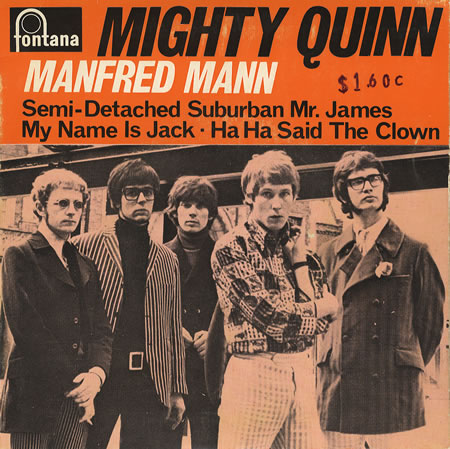
Jones was replaced by Mike d'Abo in July 1966,[7] and the group switched labels to Fontana Records,[7] where they were produced by Shel Talmy.[7] Their first Fontana single, Dylan's "Just Like a Woman", released in July, scraped in the UK top ten, reaching number one in Sweden. Their annual long-player, As Is, followed in October, with increased studio technique sidelining jazz, soul and blues roots and centering on the group's strongest set of songs so far.[8] The next two singles "Semi-Detached, Suburban Mr James" and "Ha Ha Said The Clown" both reached the Top 5. In December another EP set of instrumentals, Instrumental Assassination, was released[9] but an instrumental version of Tommy Roe's "Sweet Pea" only reached #36 when issued as a single and the follow-up, Randy Newman's "So Long, Dad", with its intricate keyboard arrangement, missed the top twenty altogether, making 1967 an unsuccessful year in the charts with no album as Mann and Hugg explored other avenues of their career. 1968 brought two albums, the Mann-Hugg soundtrack to the film Up the Junction in February and Mighty Garvey! in July. They had a resounding success with "Mighty Quinn", their third UK #1 and third hit Dylan song,[2] which also peaked at #3 in Canada and #10 in the U.S.A.
In June 1968 the following single, John Simon's "My Name is Jack", was recalled when the U.S. company Mercury Records complained about the phrase "super spade" in the lyrics, delaying release by a week until the wording was re-recorded.[10] Their December 1968 release "Fox on the Run" reached #5 in the UK.[1] The group split in 1969, while their final hit, "Ragamuffin Man", was in the Top 10.[2]
Aftermath
Mann and Hugg were already writing advertising jingles at the group's demise but continued to work together in a group format[1] with Manfred Mann Chapter Three, an experimental jazz rock band described by Mann as an over-reaction to the hit factory of the Manfred Mann group.[11] For a moment their musical worlds coincided: a TV cigar advertisement, a long track from Chapter Three's first album and "A "B" Side", the flip of the old group's last single, all used the same riff. The new group was, however, short lived and by 1971 they had disbanded and Mann had formed Manfred Mann's Earth Band.[1] In June 1983 Manfred Mann briefly reformed for an appearance at the Marquee Club in London, to help celebrate the club's 25th anniversary.[12]
In the 1990s most of the original 1960s line-up reformed as The Manfreds, minus Manfred Mann himself (hence the name), playing most of the old 1960s hits and a few jazz instrumentals, sometimes with both Paul Jones and Mike d'Abo fronting the line-up.[3] McGuinness formed McGuinness Flint in 1970, scoring a few hits before they disbanded in 1975. Both Jones and McGuinness have been mainstays of The Blues Band, which they helped form in 1978.[3]
In 2009 The Manfreds; Mike D’Abo, Mike Hugg, Paul Jones and Tom McGuinness joined Klaus Voorman performing a version of Mighty Quinn for his first solo collection A Sideman's Journey credited to "Voormann & Friends."
[edit] Personnel
* Manfred Mann - keyboards (1962—1969)
* Mike Hugg - drums, vibes, keyboards (1962—1969)
* Dave Richmond - bass (1962—1964)
* Mike Vickers - guitar, alto sax, flute (1962—1965)
* Paul Jones - vocals, harmonica (1962—1966)
* Tom McGuinness - guitar, bass (1964—1969)
* Jack Bruce - bass (1965—1966)
* Klaus Voorman - bass (1966—1969)
* Mike d'Abo - vocals, keyboards (1966—1969)
* Glyn Thomas - drums (Mann Hugg Blues Brothers; 1960—1962)
* Tony Smith - bass (Mann Hugg Blues Brothers; 1960—1962)

Some nice period performances...
Do Wah Diddy
Sha La Lahttp://www.youtube.com/watch?v=pka6mDVQkY0
My Name Is Jack
http://www.youtube.com/watch?v=0pbuWH3Q ... ature=plcp
Blinded By The Light
http://www.youtube.com/watch?v=mPreZmMT ... ature=plcp
MIGHTY QUINN...1967...one of my all time favorite radio hits from the 60's
http://www.youtube.com/watch?v=-qoyWU_EDDU
Blinded by The Light..the Earth Band...live 1976...so damn great! Some sweet guitar riffs here!
http://www.youtube.com/watch?v=sRtAJy2nFVM
We could go on all day!! Enjoy....Earth Band tomorrow...