NO OTHER-full album play!..listen and read on.
http://www.youtube.com/watch?v=oPghGSOrHFk
"NO OTHER"--Gene Clark
....................
The Byrds, hailed in the beginning as the American Beatles, turned out to be as fractious and egotistical as their UK counterparts were tight, gang-like and grounded. Possibly for this reason, the Byrd deemed to be the heart, the driving force of their rich music, has shifted over the years: initially it was Roger McGuinn, architect of their jet-age jangle, and it stayed this way during the group's lifetime; the spotlight shifted to the smug hippydom of David Crosby in the Seventies afterburn; and then on to Gram Parsons, somehow deemed the most 'authentic' Byrd in the country rock-obsessed Eighties.
Sweet Gene Clark. How sad and typical of his ill luck that he died in 1991, just as the consensus swung his way.
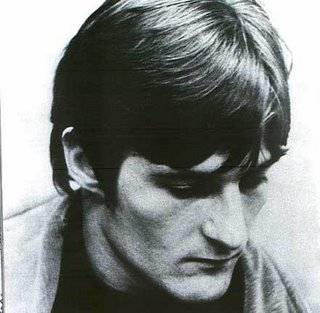
He had been the most handsome Byrd and their finest and most prolific songwriter, but on stage he was sidelined as tambourine player, a proto-Davy Jones. Fear of flying meant he would leave and rejoin the group on several occasions - it also hindered the promotion of any subsequent Clark projects. For decades, ludicrously, he remained a well-kept muso/fanboy secret.
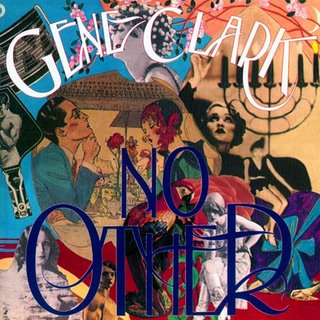
No Other, a dark, baroque album is central to Gene Clark's critical rebirth. The artwork is a giveaway, a collage of Twenties glories with Anita Loos and other sexy flapper chums at its heart. Hollywood Babylon revisited. On the back, rugged Gene appears in mascara and billowing drag. He looks quite terrifying. Drawing parallels between the decadence of the Twenties and the coke-addled extravagance of the mid-Seventies, Clark fashioned a suite of songs that was a pure, personalised Americana, a distillation of all he had seen and learnt from his childhood in Missouri and his adult years in LA. Brian Wilson and Van Dyke Parks had talked of their aborted Smile album being "a Gothic American trip"; likewise, Clark's fellow country rock traveller Gram Parsons once expressed a dream of creating Cosmic American Music. No Other was the real thing.
Aside from his mastery of melancholy, there had been few clues in Gene Clark's back pages that he would deliver something this wild and dark - his last fully realised album had been the beautiful but spartan White Light in 1971. The turning point was meeting the producer Thomas Jefferson Kaye, a Steely Dan acolyte and one-time colleague of the wunderkind producer Curt Boettcher. Their shared love of Zen Buddhism, booze and drugs took them to the Village Recorder studios in west LA in March 1974 with $100,000 from Asylum Records burning a hole in Kaye's pocket.
He had just massively overspent on a Bobby Neuwirth album and now saw No Other as "my Brian Wilson extravaganza". As for Clark, the record was "all about soul searching". Eight songs in six months suggest that there was plenty of that.
Life's Greatest Fool is a misleading opener, being an exercise in fine country rock with only the gospel harmonies and cautionary philosophy there to cause a stir. The gothic undertow of Silver Raven, all "darkened waters" and "troubled sky", veers into Johnny Cash territory. The title track is where things take a wholly different turn, a hypnotic almost funky piece which occupies the same niggling darkness as David Bowie's Golden Years. Apparently it took a week before the musicians got their first take and you can sense the numbness, the intoxication.
Strength of Strings is the album's centrepiece. The brief Clark set himself was to convey the subconscious way in which music is created, how it can be so magical, spiritual, overwhelming. No less. He pulls it off with a slow-burning intro of near-oriental harmonies, almost treading on Crosby, Stills and Nash's toes, while Kaye adds layers of ghostly church voices until the whole thing explodes with Clark's tearful tones - "In my life the piano sings, brings me words that are not the strength of strings." Side 2's opener, From a Silver Phial, is almost light relief, though its lyric - criss-crossing between the tale of a cocaine casualty and a sensual master-servant saga from the old South (or is it Hollywood?) - is as much the opaque heart of No Other's mystique as Strength Of Strings' grandeur.
The eight-minute Some Misunderstanding came to Clark in a dream which he dictated to his wife in the middle of the night. Its vagueness is its beauty, beginning as a meditation on how to take a relationship forward then ruminating on the recent death of Gram Parsons - "We all need a fix, but at times like this, doesn't it feel good to stay alive?" It soars and floats over pedal-steel and organ interplay (the cream of LA session players, anyone you care to name) and hangs eerily in the air, unresolved. Passing through The True One, another country-rock interlude, we reach the climactic Lady of the North, "like silver on the ocean shore". Clark sounds awed, lovestruck, and never sang better, reaching from rumbling baritone to near-falsetto (think of the middle eight of Elvis's Any Day Now and you're close). Dense and hypnotic, his voice weaves in and out of the piano, cello and electric violin - when the shimmering coda arrives it is pure release.
Over the years No Other has been lauded by some but frequently criticised for over-ambition (David Geffen at Asylum concurred and put no promo effort in - it consequently sold zip). This is conservatism on a par with Mike Love's criticism of Pet Sounds. Recorded in a stultifying era of newly-minted and consequently too-cosy singer-songwriters, the result of Gene Clark's search for America's dark heart seems all the more impressive. And it sounds deeper and stronger with each passing year. What a terrible pity he isn't around to receive his standing ovation.
Posted by Bob Stanley at Monday, January 16, 2012 - croydon municipal
............................
GENE CLARK - ZENMASTER
By Steve Burgess 1976
"...In the end they traded their tired wings
For the resignation that living brings
And exchanged love's bright and fragile glow
For the glitter and the rouge
And in a moment they were swept
Before the deluge ..."
Jackson Browne: "Before The Deluge"
That song is an elegy, a dirge, a lament. For Jackson Browne,
boy-child of spiralling sixties circumstances - Ciro's where The Byrds
parcelled light up into musical segments, and Sunset Strip where the
strange young girls offered their youth on the altar of acid - it is a
statement on a generation. From an outsider. And, consequently maybe,
earnest family-man Jackson has presented us with a capsule of truth. No matter which flank you choose to attack the song on, superficially naive though it is, he has the angle covered. For so many resigned their colours, returned to tug at society's skirts that the deluge, the personal apo-calypse of a generation (whatever a generation is) is now seen by Dylan's Mr. Jones as a passing cloud, an aberration, another youthful media-hyped gangbang. Not so, but why bother to prove it now. The Byrds took it to the limit. And The Eagles are goin' back.
Rock is a communications system fallen into disuse, like smoke
signals. When Love and The Byrds hit the Strip, electric rock was still as brand-showroom-new as the dishwasher of the future - maybe rock will be the dishwasher of the future - and, as baffling new musical and linguistic vocabularies hit the West Coast like some pack of outlaw hikers, a revolution hit the music industry, if nowhere else. California dreamin' became a new parlour game: cigar chomping hack tunesmiths no longer poured their soft-headed conception of teenage life and love over the radio landscape and suddenly it seemed everyone from wholemeal highschool kids cutting out on Mary Jane-wanna to crawling kingsnake nightpersons had a band whose music soundtracked their personal reality.
Then gone in the spin of a wheel; somehow image got a foot in the door, maybe never left L.A., where all the world is but a billion dollar sensurround movie set ... never quite made it to San Francisco, Tubes notwithstanding ... glitter and rouge spread like margarine, Faye and Peter, Britt and Rod, Vincent Price and Alice Cooper and everybody all moneybound on the Las Vegas Flyer. Goodbye to the kid next door with the red Stratocaster and let's have a warm welcome for dry ice, perspex drums and leather-look machismo. Frank Zappa once held forth: "A freak cares what he looks like, a hippie doesn't". Guess there were a lot of freaks about.
The humble, bumbling hippie has a financial empire built on his shoulders, and, with Vietnam out of the way, teenage America could lapse back into the trivial, although it kept the stash and the stereo and demanded, "Feed me". Mr. Jones still didn't know what hit him but, with hindsight, it seemed harmless enough.
In music, a few people didn't know when to shut up and behave, which of course, might help their record companies to shift a few more units. And, probably, their audience is confined forever to the few survivors of the deluge, to use "Jackson's Metaphor", unless, somehow, like the Starship, they can cross upmarket. Like playing Russian Roulette with five loaded chambers.
Gene Clark left The Byrds after "Eight Miles High" and shut up, only to find himself a unique style of self-expression.
But to hell with sociological background (pause) , ladies and gentlemen (fanfare), Gene Clark, Zenmaster. (Applause).
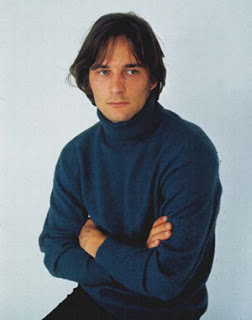
Harold Eugene Clark, born Tipton, Missouri, 1941, a simple country boy of a large country family, no doubt spent a lot of nights listening to whippoorwills and winds; mournful mountain music is his stock in trade. He professes to making surf music in school, graduating to a twelve-string folk thing on the same circuit as journeymen Brewer and Shipley, before being appropriated by the New Crusty Nostrils to play on two albums and that monument of disgusting ephemera, "Green Green". No doubt fully revolted, Gene cut out in L.A. and hung around the Troubadour where Beatlemaniac McGuinn regularly performed select-ions from the furry four's song-book. Gene began to sing along, the story goes, as did another ex pre-packed folkie casualty, chubby David Crosby. After a few amply documented false starts and many cigarette butts, The Byrds appeared, stomping cuban heels and blast-ing ozone all over the airwaves.
Gene was genuinely the moody one, gaunt, rattling tambourine, supplying their best homegrown material, yearning even then. Witness "Here Without You". Like Rothmans, The Byrds became international, had to go places, but Gene balked, he'd seem an aircrash first-hand; no way did he want to fly, "...the pressure did me in." He rejoined a couple of times but couldn't cut it, and decided that solo was the way to be, a personal singer wanting to make a personal statement. For The Byrds, "5D" came and went while Gene meticulously constructed the world's first country-rock-super session album, "Gene Clark And The Gosdin Brothers", with Chris Hillman, Mike Clarke, Leon Russell, Glen Campbell and Clarence White. It was finally released in early '67, the same week as "Younger Than Yesterday". There were few completists, scholars and connoisseurs around then: Gene was simply forgotten and the new Byrds album had the same effect on Gene as Kryptonite used to have on Superman. No contest.
Gene stepped up the gigging, ran into Doug Dillard and between them they collected an amorphous gaggle of musicians to form the Expedition, a band woefully out of step with public taste, a true contemporary country band in a world that wasn't exactly overjoyed by The Byrds' perverse-seeming, Parsons-inspired leap into country with "Sweetheart of the Rodeo", a move in which Doug had a small picking hand. It seemed both Gene and Doug had room to stretch out in their framework and the first album seemed to bear this out. (A&M SP4158 1968). For this, Gene collaborated heavily with Bernie Leadon, only "Out On The Side" was written alone, and that stuck out like a frozen nose. Nevertheless, it's an incredible waxing, lively and confident; it's companion piece, "Through The Morning Through The Night" (A&M SP 4203) which emerged in 1969, wasn't so strong, a diverse conglomeration pushing two ways. Gene was being forced into a stylistic corner by ripsnorting bluegrass with which he was uncomfortable, although "Polly" is a breathtaking wispy song in a style he would later explore, chart and claim, and his readings of the Everly's "So Sad" and Lennon-Macca's "Don't let me down" fill the room with the Clark primal melancholy. Gene then split; and the Expedition went on to become wholly unnecessary as Country Gazette and Pseudo Burritos.
By now Gene had already thrown away the key on two albums worth of material recorded before the Expedition, and he now embarked on another round of aborted projects: A single with the original Byrds - "One In A Hundred" which surfaced on "Roadmaster" (after the "White Light" cut) - and a session for the third Burrito's elpee which produced "Here Tonight" - variously on "Roadmaster", "Close Up The Honky Tonks" and "Honky Tonk Heaven - which would have eclipsed everything else on it; maybe that's how it got shelved. More backlogs, brick walls; Gene moved to Mendocino, where something happened to Gene; no doubt it was always there, but communing in
solitude with his twelve-string in '70 and '71 exposed a tradition to which Gene Clark belongs, musically unparalleled but with clear literary and spiritual precedents. It is apparent. It is there on "White Light", a verbal facility once devoted to love songs, turned in on itself, twisted into alien blueprints of personal philosophy.
"White Light", produced by Jesse Ed Davis, released 1971 on A&M SP 4292, is a blazing, multi- faceted statement. Always the unstated enemy of the rational, the orthodox, Gene now attacked perception itself; by the time "No Other" was made, Gene finally had no need of even that, but by this time those who had listened to "White Light" could make that transition. However, the white-walled room "out on the end of time" became no longer a metaphor but an actuality as Gene emphasised one-ness with the
universe, the white light once talked of by acid-heads, the living nirvana in which all references cease to operate. In fact the way of Zen...
The album opens with "The Virgin", with his new-found, almost Shakespearian, use of language directed towards connecting "The Virgin" - a virgin only in the abstract - with "wisdom's karmic ocean"; the revelation that "lifeforms are insane" becomes "the melodies of meaning/ the sad song she learned to sing". Like an Old Testament prophet, he pushes his created character through a re-birth with which she must come to terms, and asks, "was this her revolution, just a child in love's crusade?"; she is pushed past a point of disillusionment, on the far side of which lies only insanity or acceptance. Gene clearly sympathises, and, himself, accepts.
In "From a Spanish Guitar", Gene, unique for a rock musician, presents himself as no more than a mouthpiece for the elements, for
children and the insane, all of which "flow safe through my soul and my brain and a Spanish guitar". By giving voice to these things, but allowing them to express no opinions, they make no point but to assert their existence ... as in Zen, they must be understood on their own terms. Later Gene returned to his obvious belief that music is, in itself, sometimes one of the purest everyday forms of the Zen philosophy, (since the conversion of sound into meaning is such a subjective process), in "Strength Of Strings" only in a purer form, since, there, all that protests its existence through Gene is the music itself.
"White Light" itself is a difficult riddle; seemingly too personal to
penetrate, it paints pictures of a village and its people "enlightened by the land", but also seems to encapsulate Gene philosophy. Anyone familiar with Zen will be familiar with the precept: "Those who know do not speak, those who speak do not know". I, as the writer of this would find this insoluble if it wasn't for the facts that, through Zen, I need not examine it ... nevertheless; in "White Light" that maxim is interpreted: "The communion of the forces take delight with the theory that no tongues can read or write ... white light." Indeed.
But, like all creations, Gene's songs need an audience; one acclimatised [sic] to the oblique and the metaphorical ... once there was a spateof extravagant claims that rock lyrics were capable of standing as poetry,mostly confined to the hysterical drivellings of indulgent jazz critics. Not so, poetry is dehydrated, disciplined ideas, economy is necessary; rock lyrics have a tendency to dissipate, to fall apart in the mind - if they haven't done so in transit from speaker to ear. In between these poles are the media of print, sources, texts. We have to cast an eye over what are ref erred to as "cult" books, things that, in conventional terms, hit the
impressionable reader right between the frontal lobes and which he is
conventionally supposed to grow out of: like bluegrass, rock, dope, and sassafras tea. Mixed blessings come of them, secretaries gobbling Von Daniken, active lives reduced to infinite indecision by overdoses of I Ching, Manson taking "Stranger In A Strange Land" as a blueprint and an excuse ... but also the permanent redirection of aimless lives through "The Electric Kool-Aid Acid Test", "On The Road", or Guthrie's "Bound For
Glory", and the rediscovery of a sense of wonder and sensory excitement through Brautigan, Tom Robbins or even the catch-all "Zen And The Art Of Motor-Cycle Maintenance". That word again. Read through a cross-section, and, ultimately, depending on where your ethics come from, you will find strong traces of what could be called "Nihilism" - lack of responsibility - but which I prefer to term Zen - a sense of continuity; of what is relevantand what is ephemeral, dead wood.
On the psychotropically-steeped West Coast of America, cults regenerate infinitely, and the biggest, brightest, five-star legend is that of Don Juan, brujo (medicine man, wizard, sorcerer, shaman, choose one), the great brown hope of the acid generation as it sits around debilitated, thirsting for new texts. Don Juan, new readers start here, is the hero of a series of four books by Carlos Castaneda, who supposedly met the old Hopi Indian at an Arizona bus depot while researching for his PhD and became his pupil, embarking on a decade-long struggle to become a brujo himself, through learning to "See". Castaneda has now admitted Don Juan to be a figment of his fertile imagination, confirming the suspicions of many who found Castaneda's stupidity and credulousness (in the books) to be literally, too much to be true. Nevertheless, the teachings of this
fictional ultimate guru represent an extraordinarily clever and successful attempt to recycle whole fertile areas of Western and Eastern thought into one hybrid discipline and philosophical system. Castaneda, with one sustained metaphor, kept millions dreaming in the wake of the soured Alternative American Dream, stopping off along the way at Nietzsche, Sufi Tales, Tim Leary, the Bhagavad-gita, the I Ching, Crowley and the Tarot, Vonnegut, and, particularly, Zen. A priceless con; and one that loses nothing from the fact, because that metaphor has created a new vocabulary for others to communicate with. The ends justify the means; Don Juan enables Castaneda to fly and refuses point blank to categorise whether this is fact or an illusion; as far as he is concerned it is ir-relevant, the distinction means doodly-squat. This is Zen thinking. It's also a good commentary on the value of the books. The Eagles wrote "Journey Of The Sorcerer" and "Visions" about Don Juan and announce them from stages everywhere as "for all you Castaneda freaks". Garcia sings "I was blind all the time, I was learning to see" ("Help On The Way") with an inflection that leaves no doubt about its meaning. And Gene Clark wrote "Silver Raven" - a creature with origins in Don Juanology - and sang it on tour with Roger McGuinn, a year before it came to rest on "No Other", the album which gives Castaneda's Folly a practical expression. Castaneda gave Gene Clark, Zeamaster, a framework to work in.
Nevertheless, "White Light" sold like umbrellas in the Sahara, in spite of favourable critical action, although these plaudits were more directed to the honest grainy sound than actual content, and '72 saw Gene clearing the air for his no doubt rather nebulous new direction. He assembled a stalwart band of faithfuls - Clarence White, Sneeky Pete, Spooner Oldham, Mike Clarke and Byron Berline - and in April to June cut eight tracks for a projected album which eventually metamorphosed into the Dutch semi-compilation "Roadmaster" (A&M 87 584 IT). The reasons behind Gene dropping the whole project like a hot burrito are uncertain, certainly the character of the songs, with the exception of the ugly, out-of-character "Roadmaster" and the oblique, post-apocalyptic "Shooting Star" (obviously a "White Light" holdover), suggest a man working through an old catalogue of songs which he had by then, outgrown.
This obsession with setting business in order led Gene and Jim Dickson to enter Columbia's L.A. studios that year to re-mix and re-record vocals for Columbia's projected re-release of the Clark/Gosdins album. In the space of a week they transformed the thing into "Early L.A. Sessions" (Columbia KC31123), a lovingly documented artefact, but minus "Elevator Operator" which supposedly did not stand the test of time and brought the playing time down to a ludicrous 23 minutes. Essential seminal stuff nevertheless, particularly "Tried So Hard", "Keep On Pushing" - to which the label enigmatically appends "Doug Dillard on electric banjo" for some obscure reason - "So You Lost Your Baby" and the eerie "Echoes": This was Gene's first foray into the human psyche, and one which once frightened your commentator truly rigid for a deeply personal reason, because "Echoes" reflects the fact that lovers reach points from which they can no longer continue together, but for no nameable reason, and with no loss to the forces that held them together, as I was finding out, regretfully, at the time I first heard the song. '72-'73 also saw the renowned re-formed Byrds debacle on Asylum SYLA 8754, the label to which Gene had recently signed. To some it seemed that the album was to be used as a vehicle to shoot Gene to stardom status, but he wasn't having any, content to dredge up "Full Circle Song" (also on "Roadmaster" and probably dating, therefore, from as early as '68) and "Changing Heart" which neither adds nor subtracts anything from Gene's philosophies, unlike "Full Circle" which is his expression of the Eastern notion of a cyclical universe, as portrayed in the I Ching and Tao Tse Ching. Gene also paid tribute to Neil Young by recording "Cowgirl In The Sand" and "See The Sky About To Rain". both sensitive, if detached, readings; the best that can be said for the album is that Gene fared better in the ego-centric paws of producer Crosby than did McGuinn and Hillman.
However, deByrded McGuinn was now truly out on the side along with Gene, who left his North California eyrie to share a house with him in '73, and, during this time, to sit in on the "Adventures Of Roger McGuinn" tour, where he per-formed "Silver Raven" to a few select, but disinterested
audiences. And with that, Gene Clark left the musical community to its own devices.
The facts pertaining to the release of a record album by Gene Clark on Asylum SYL 9020 late in the year 1974 are plain and clear enough; fifteen musicians, eight back-up singers and producer Thomas Jefferson Kaye helped him make it in L.A. and San Francisco over a period of six months. The cardboard, paper and plastic object they spawned is conversely, something that over-reaches itself and becomes impossible to rationalise or focus on. The cover is deliberately and monstrously inappropriate; every image, the whole conception, is totally dislocated from the content of the music. And so it becomes irrelevant, and, mocking the whole concept of record sleeves as it goes, winks out of existence slowly, leaving the listener no clues to help deal with what it contains.
The lyrics are printed on the inner sleeve, and that's another red herring. These lyrics should not, and cannot, stand that sort of scrutiny since most don't make any conventional sort of sense; they are inseparable from the music and must not be approached, it would be like trying to read the maker's name on a rainbow. And Zen teaches that words are a clumsy vehicle for communication, since they can only present ideas as tiny particles of information, and not as totalities. So ignore it, and there's only the music left.
Like "Astral Weeks", "No Other" comprises only one multi faceted song. Play it, and the twin speakers become twin facing mirrors, endlessly regenerating, a link with infinity; its subjects are reality and time and spirituality and dreams and how to come to terms with the world. And for this it is a totally unique work; rock has always had its intellectuals with palpitatingly eager audiences ready and willing to snarf up their ephemeral pap as significant. Maybe I do Gene Clark a disservice to treat his music this way, as heavy duty profundity. At least I am convinced this record should be taken seriously. It's not merely entertainment.
Side one opens with "Life's Greatest Fool", a mid-tempo rocker building slowly to piledriver level, Gene declaiming a long series of dislocated images and observations, some obvious, some mysterious cats-cradles, asking, "Could these be reasons why man is life's greatest fool?" The term "fool" is ambiguous anyway, since it could be taken to mean "innocent" as in the Tarot, and, paraphrased, the song asks whether man is misguided to continually question and attempt to explain what he perceives. The alternative is the Zen outlook ... and Don Juan tells Castaneda that he must cut down on the internal dialogue if he is to "See". Gene Clark re-affirms this, and gives a model for this point in the image of the "Silver Raven", the next track, and a creature from out of Castaneda's back pages. In this song, the raven contemplates a coming, nebulous, apocalypse. Four times Gene asks whether he has seen (Seen?) these things, seen "the old world dying". "Silver Raven" celebrates the insularity of man's view that he is in control of his world, and advises spiritual unity with the elements.
"No Other" follows. and sets these conclusions out again almost in the form of an I Ching hexagram: "Then the pilot of the mind must find the right direction". Distilled, the song says that to personify love as "God" and to commune with him alone, is to Deny "the tide of life that flows in each direction". Gene sees God as a form of human collective consciousness; "All alone we must be part of one another", and the side closes with "Strength of Strings" in which Gene claims that music works through him rather than vice-versa. "Strength Of Strings" is a vast, elegaic, panoramic hymn and everyone performs as if posessed. It is its own explanation, a self contained world, in which "I am always high, I am always low, There is always change" - the Eastern notion of a cyclical universe again, first explored in "Full Circle Song".
"From A Silver Phial" leads off the second side and is essentially a love song, the first of two. "Phial" is a highly explicit song about a
particular woman and communicates nothing at all, except for a lingering impression strong enough to make you feel that you know her from somewhere. The virgin? Visionary use of words "... said she saw the sword of sorrow sunken in the sand of searching souls" more use of the universal symbolism of the Tarot. A Zen love song. Like love, it is beyond rational thought, and contrasts well with "Some Misunderstanding" which follows, in which Gene talks directly to the listener about fate and the future. He seems to be exposing his fallibility as a philosopher, examining his position in detail and expressing his human fears, but returns to a basic philosophy - "We all need a fix at a time like this but doesn't it feel good to stay alive". "Fix" is used for its ambiguity, its overtones of smack, but
primarily in the sense of a bearing, a direction. The rest of the album acts out the directions ... The penultimate song, "The True One" is lighter in sound and context than the rest, a throw-back to simpler times in its construction, a recollection lyrically of Gene's rock star past, which he plainly regards as mis-spent - presumably because of its emphasis on the material - and presented as a long stream of mottoes and aphor-isms, like a Sufi tale. It also contains an observation of reality; he plainly believes himself to have evolved into a different reality, separate and distinct, the true one.
And finally, in "Lady Of The North", the second love song, he sings of his alternative reality as a change in the wind that must come, natural and destined. The song has an immense rhapsodic grandeur, an illusion of free flight. "Ah, fine lady of the North, like silver on the ocean shore "No Other" is now deleted. Gene Clark has no recordings currently available in this country. The album he has been working on for the past year, reputedly a "Country-Motown" synthesis, does not appear. Asylum have no release scheduled.
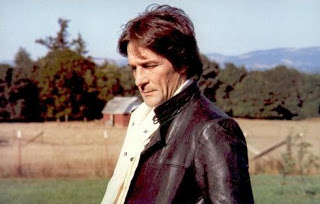
Gene Clark was "pretty happy" with "No Other". "You could call this a transition for me. I'm moving into another, bigger arena."
Good grief, some of us think "No Other" is one of the finest albums ever cut. Where can he take us to next? Trust the man who knows the Strength of Strings.
STEVE BURGESS
DARK STAR #3
DARK STAR PUBLISHING 1976
NO OTHER
http://www.youtube.com/watch?v=GilrLIwBJE8

