NIC JONES
Canadee-I-O
http://www.youtube.com/watch?v=olplcsNuqyg
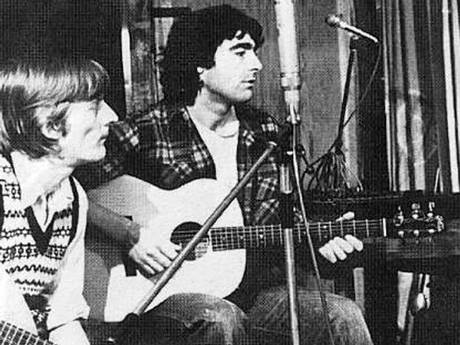
Nicolas Paul "Nic" Jones (born 9 January 1947) is an English folk singer, fingerstyle guitarist and fiddle player whose professional career spanned the years 1964-1982. He recorded five solo albums, and was a frequent guest performer.
Nic Jones was born on 9 January 1947 in Orpington, Kent. He first learned to play guitar as a young teenager and early musical influences included such artists as The Shadows, Duane Eddy, Chet Atkins, Wes Montgomery and Ray Charles. His interest in folk music was aroused by an old school friend, Nigel Paterson, who was a member of a folk band called The Halliard. When the members of the group decided to turn professional, one of them left to pursue a different career and Nic was invited to take his place. Whilst playing with The Halliard, Jones learned to play the fiddle, and also how to research and arrange traditional material. The group toured the UK between 1964 and 1968, eventually splitting up when two of the members decided to pursue careers outside the folk music business.
In 1968 Jones married Julia Seymour and they eventually were to have three children together – Daniel (d), Helen and Joe. The couple settled in Chelmsford and Jones decided to pursue a career as a solo folk artist. He started playing professional gigs in 1969, and in 1970 released his first album, Ballads and Songs for Trailer Records.Between 1971 and 1980 Jones recorded four more solo albums - three more for Trailer Records and his last, "Penguin Eggs", for Topic. Apart from Jones' trademark vocals, fingerstyle guitar and fiddle, the records also introduced guest instrumentalists playing piano, harmonium, bodhran, melodeon and recorders.
During his career, Jones was much in demand as a session musician and he guested on albums by leading UK artists such as June Tabor, Shirley Collins, Barbara Dickson, Richard Thompson and many others. He was also a member of short-lived folk group "Bandoggs", comprising Jones, Tony Rose, Peter Coe and Chris Coe, and which released one album in 1978.

On 28 February 1982 Jones was involved in a serious road traffic accident. Returning home by car after a gig at Glossop Folk Club, on the road between Peterborough and March in Cambridgeshire, Jones, tired, inadvertently drove into a lorry pulling out of Whittlesea brickworks. He suffered serious injuries, including many broken bones and brain damage, and required intensive care treatment and hospitalisation for a total of eight months. His injuries left him with permanent physical coordination problems, unable to play the guitar as well as before, and no longer able to play the fiddle at all. The accident effectively ended his career as a touring and recording professional musician.
Jones now lives in Devon and continues to play guitar and write songs for his own pleasure and enjoys playing chess. His wife Julia set up the record label Mollie Music which has issued four albums of re-mastered live recordings from Jones's early career.
On 5 August 2010, after an absence of 28 years, Jones made a return to the stage. He appeared at an event dedicated to his music at Sidmouth Folk Week. Jones sang three songs with one of his former bands Bandoggs and commented that he would "consider performing again – but wanted to sing his own songs."[8] In 2012 Nic Jones (with musicians Joseph Jones - Nic's son - and Belinda O'Hooley) performed his first solo concerts for 30 years at the Warwick, Cambridge, Wadebridge and Towersey folk festivals. On 22 September 2012, Nic Jones was presented with The Gold Badge of the English Folk Dance & Song Society at a special concert at Cecil Sharp House, London. It is the highest honour the E.F.D.S.S. can confer on a musician. On 30 January 2013 Jones was named Folk Singer of the Year at the BBC Radio 2 Folk Awards. On 23 August 2013 the Nic Jones Trio (comprising Nic, Joseph Jones and Belinda O'Hooley) performed on the opening night of that year's Shrewsbury Folk Festival, in the course of which it was announced from the stage that it was to be their final performance.
Guitar style
Jones developed an intricate, rhythmically-complex fingerpicking and strumming guitar style. He started off playing in standard guitar tuning (EADGBE) but then gravitated towards a variety of open tunings after hearing the recordings of Martin Carthy, whom he acknowledges as an important influence. These included tunings such as the well-known DADGAD, but also variants of C and G major/minor/modal tunings heard on such tracks as "Canada-I-O" and "Billy Don't Weep For Me". Jones was also influenced by classical and flamenco guitar playing.
He played a Fylde Orsino acoustic guitar with a plastic thumb pick and "bare" fingers. Jones plucked the strings with some force causing the strings to lift up and rebound against the fingerboard - accounting for the "spitting", slapping sound characteristic of Jones' guitar accompaniments. Another important feature was a regular percussive sound made by striking downwards with the middle and ring fingers of the right hand on damped bass strings close to or above the bridge of the guitar. This is akin to the technique used by banjo players called frailing. This can be heard to good effect on such Jones tracks as "Ten Thousand miles" (on The Noah's Ark Trap, 1977) and "Master Kilby" (on From the Devil to a Stranger, 1978). Jones also skillfully used selective string damping to achieve other percussive effects such as on "Billy Don't Weep For Me" (on From the Devil to a Stranger).
A feature of his later, mature guitar style is the introduction of subtle counterpoint lines that complement the lead vocals. This can be heard on such songs as "Miles Weatherhill", "The Golden Glove", "Courting is a pleasure" and others.
Discography
Jones' first four albums were originally released on vinyl on the Trailer Records label. Currently only the first two are available on CD. Legal wrangles continue to impede Jones' full back-catalogue from being re-released.
In 2001 Penguin Eggs was voted to 2nd place in the "Best Folk Album of all Time" by listeners of the Mike Harding show on BBC Radio 2. The opening track on this album, "Canadee-I-O" was also recorded by Bob Dylan and included on his 1992 album Good as I Been to You. Some critics have accused Dylan of stealing Jones' arrangements for this song without credit or offer of royalties. Others disagree, and believe the arrangements to be different. Another school of thought is that the arranger's copyright on recordings of traditional songs is little more than a legal fiction, allowing artists to receive "mechanical royalty payments" that would otherwise be kept by their recording labels. See the links below for further discussion on this issue.
Solo
Studio albums:
Ballads and Songs (1970)
Nic Jones (1971)
The Noah's Ark Trap (1977)
From the Devil to a Stranger (1978)
Penguin Eggs (1980)
Remastered live albums:
In Search of Nic Jones (1998)
Unearthed (2001)
Game Set Match (2006)
With The Halliard[edit source]
It's The Irish In Me - The Halliard (1967)
The Halliard and Jon Raven (1967)
Broadside Songs (2005 — the Halliard songs from and Jon Raven, plus 10 more)
The Last Goodnight! (2005 — long-lost recording from 1968, plus 3 more)
With Bandoggs[edit source]
Bandoggs (1978)
With Maddy Prior and June Tabor[edit source]
Silly Sisters (1976)
Jones also sang and played guitar and fiddle on recordings by many other folk artists.
In 1999, John Wesley Harding released a tribute album entitled Trad Arr Jones.
Playlist...play on
http://www.youtube.com/watch?v=rT1r-smQ ... 670431BCA7
Receiving folksinger of the year

